
Local SEO services for small business help you show up when nearby customers search Google and Maps for what you sell. This guide is for owners deciding whether to hire help: what the work includes, DIY vs freelancer vs agency, what it costs according to published survey data, how to vet a local SEO agency, realistic timelines, and the steps you can take yourself this week.
For budgets beyond local work, see how much SEO costs across freelancers, agencies and retainers.
What do local SEO services for small business include?
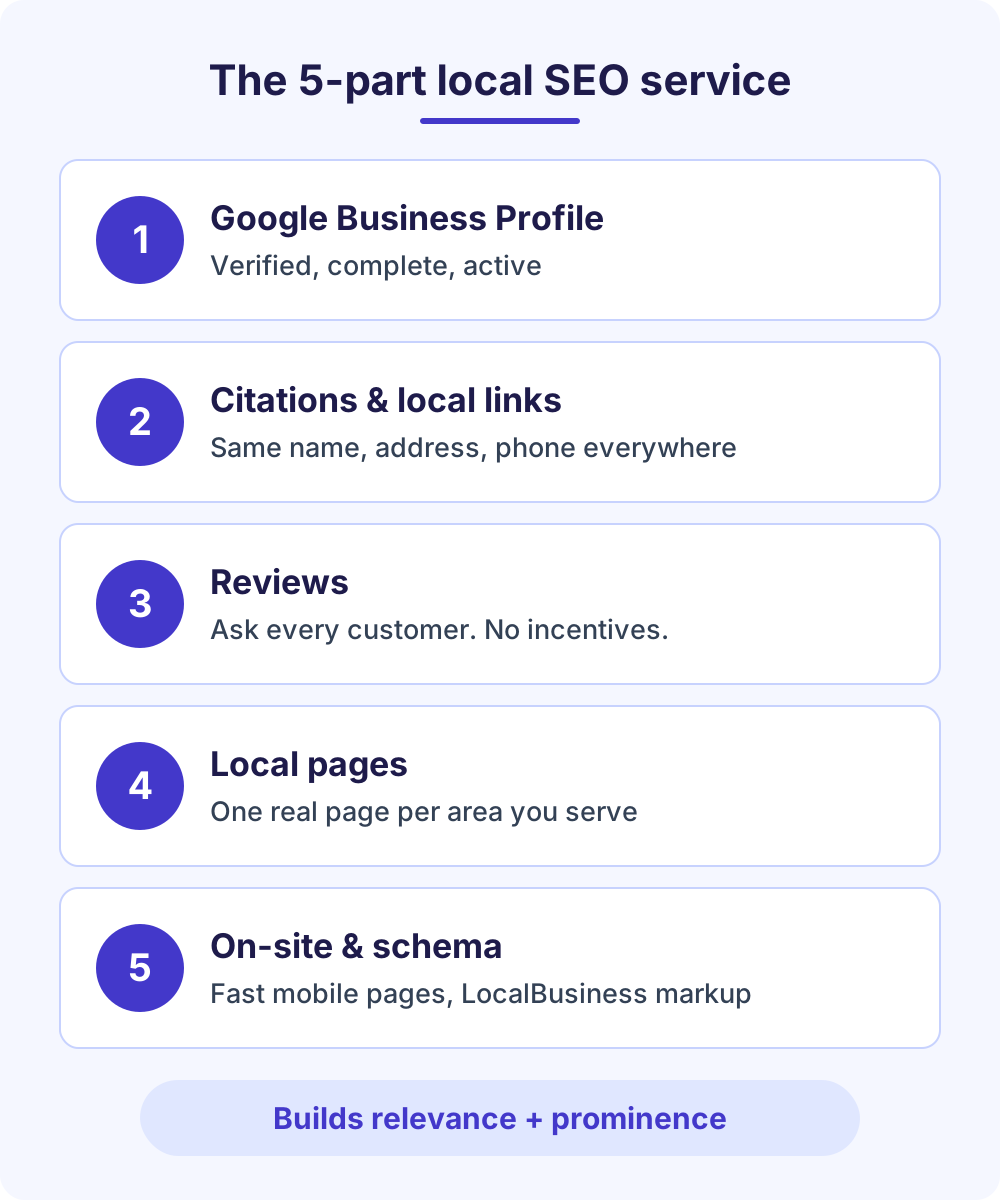
Local SEO services for small business usually cover five jobs: optimizing your Google Business Profile, cleaning up name, address and phone (NAP) citations, earning genuine reviews, building useful location pages, and on-site fixes such as LocalBusiness schema. BrightLocal’s 2020 industry survey found agencies billed about $127 an hour and freelancers $102. Google says no one can guarantee a #1 ranking, so treat any promise of one as a red flag.
In this guide
The rest of this guide shows what good work looks like in each of those five areas, so you can do the basics yourself or judge a local SEO company’s proposal line by line.

How Google ranks local results
Local SEO for small business starts with how Google picks local results. Google says they’re based mainly on relevance, distance and prominence. Legitimate local SEO services work on relevance and prominence, because nobody can change your distance from a searcher.
- Relevance: how well your Business Profile matches the search. Complete, detailed information helps Google match you to more searches.
- Distance: how far your business is from the person searching.
- Prominence: how well known your business is. Google points to signals such as how many websites link to you and how many reviews and positive ratings you have.
Google’s guide to local ranking also states there is no way to request or pay for a better local ranking; ads buy ad placements, not a higher unpaid position. Reviews and links are earned over time, which is why local SEO is a monthly habit, not a one-off setup.
Does local SEO help in AI search too?
The same groundwork appears to matter. In BrightLocal’s September 2026 study of about 200,000 local AI searches on ChatGPT, Google AI Mode and AI Overviews, business websites supplied 42% of all citations and Google Business Profile 28.5%. A complete profile and a clear, accurate website feed both the map pack and AI answers.
The 5 parts of a local SEO service
Whether you hire a local SEO agency or do it yourself, the work falls into the same five parts. Use them as a scope checklist: a proposal that skips one should explain why.
1. Google Business Profile optimization
Your Google Business Profile is what appears in the map pack, so it’s your highest-leverage asset. Claim and verify it, then fill in every field that applies: primary category, hours (including special hours), address or service area, attributes, products or services, and a plain-language description.
Follow Google’s guidelines for representing your business closely. These are the rules small businesses break most often:
- Name: use your real-world name as it appears on your signage. Don’t add keywords, city names or service descriptions.
- Address: list a real location. P.O. boxes, remote mailboxes and virtual offices aren’t eligible.
- Service-area businesses: if you visit customers instead of receiving them, hide your address and set a service area, generally no more than about two hours’ drive from your base.
- Categories: choose the fewest, most specific categories that finish the sentence “This business is a…”
- Phone: use a local number you control, not a central call-center line or a number that redirects.
Then keep the profile active: add real photos of your premises, team and finished work, and reply to reviews. Posts are optional but useful for offers and events; Google archives posts older than six months unless you set dates.

2. Citations, NAP consistency and local links
A citation is any online listing of your business name, address and phone number (NAP). Consistency matters more than volume: “123 Main St” on one site and “123 Main Street, Suite 4” on another can look like two different businesses to software.
Start with the major map and directory platforms: Bing Places for Business (free, and it can import your listing from Google), Apple Maps through Apple Business, Yelp, and the leading directories in your industry, such as Avvo for lawyers or Healthgrades for medical practices. Audit old listings for outdated addresses and phone numbers, and fix those before you create new ones.
Because Google counts how many websites link to your business as part of prominence, good providers also earn local links: chamber of commerce and trade association listings, supplier and partner pages, community events and local press. Links must be earned, not bought; Google’s spam policies treat buying links for ranking as link spam. Our guide to safe link building services explains what to accept and what to refuse.
3. Review generation that stays within the rules
Reviews affect both your ranking and whether a searcher calls you. Google notes that more reviews and positive ratings can help your local ranking. The process that works is simple: ask every customer right after the job, and send your Google review link or QR code so they don’t have to search for you.
Two sets of rules apply, and any local SEO company you hire must follow both:
- Google’s fake engagement policy bans offering incentives (payment, discounts or free goods) for reviews, discouraging negative reviews, and asking only happy customers, a practice known as review gating.
- The FTC’s rule on consumer reviews and testimonials bans creating, buying or selling fake reviews (including AI-generated ones), incentives tied to a positive or negative sentiment, undisclosed reviews from employees or managers, and suppressing negative reviews through threats or false accusations. The FTC can seek civil penalties from businesses that knowingly break it.
Reply to every review briefly and without sounding promotional. A calm, specific reply to a complaint shows future customers how you handle problems.
4. Local landing pages that aren’t doorway pages
If you serve several towns or neighborhoods, one generic contact page won’t rank for all of them. Build a page for each real location or core service area, with content that is genuinely specific: the services you offer there, photos of local jobs, parking or travel details, and area-specific questions.
Avoid the template trap. Google’s spam policies list city or region pages that funnel visitors to one page as an example of doorway abuse. Pages that only swap the city name are a liability, so build fewer, better pages.
5. On-site basics and LocalBusiness schema
Your website backs up everything above. Show your NAP in the footer exactly as it appears in your citations, and add LocalBusiness schema markup, which you can build with our free schema markup generator. Make sure pages load fast and read well on a phone, because customers often search while they’re out.
Cover the technical basics too: verify your site in Google Search Console and Bing Webmaster Tools, fix crawl errors, and give each core service its own page. Our 20-point SEO checklist for small business websites walks through the essentials.
DIY vs freelancer vs local SEO agency
The right choice depends on your time, your market and how many locations you have. The work is the same; what changes is who does it, how fast it gets done, and how much oversight you need to give.
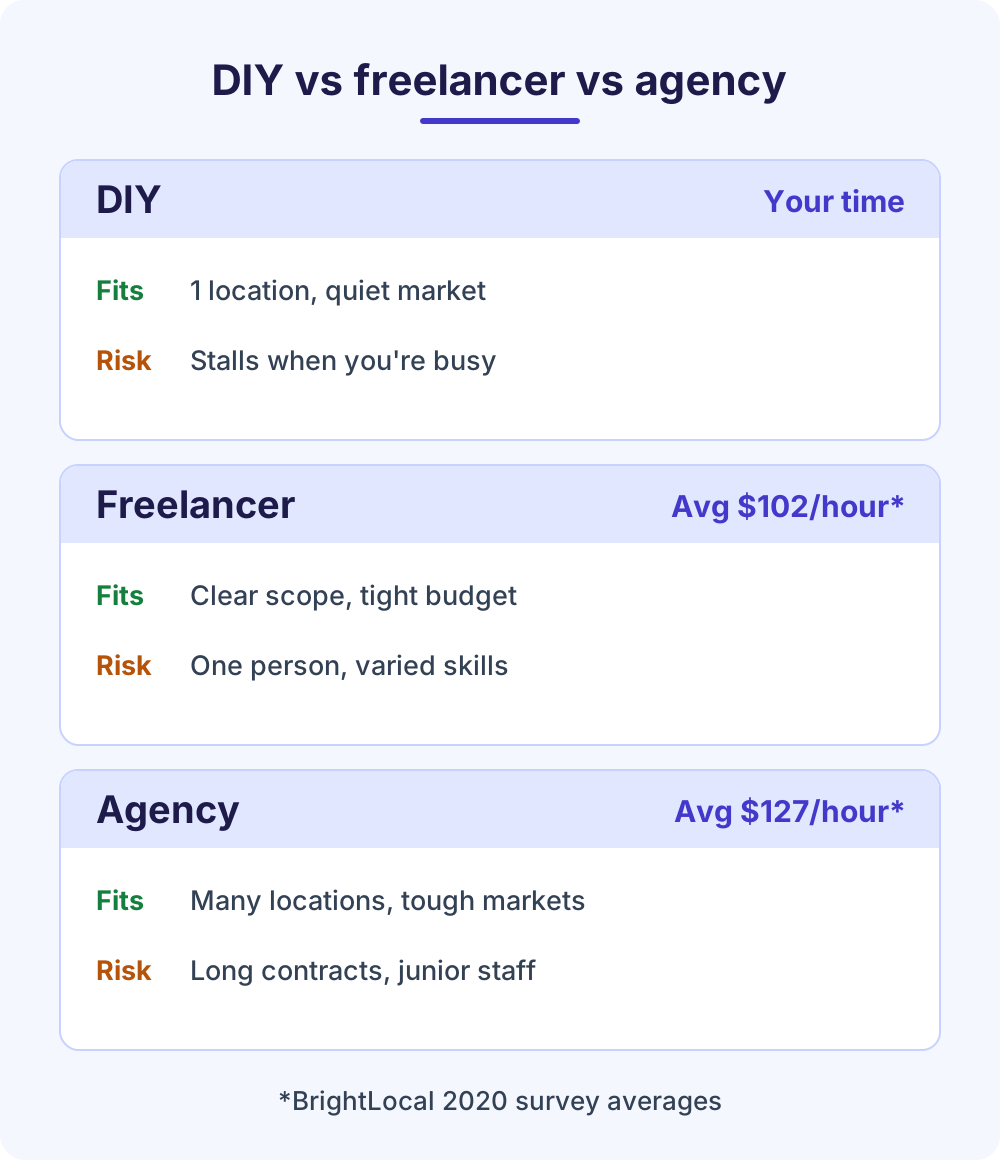
| Factor | DIY | Freelancer | Local SEO agency |
|---|---|---|---|
| Typical cost | Your time, plus optional tools | Averaged $102/hour (2020 survey) | Averaged $127/hour (2020 survey) |
| Your time | High, especially in the first three months | Medium: approvals, photos, review asks | Low to medium: approvals, review asks |
| Best for | One location in a quiet market | One or two locations with a clear scope | Several locations, competitive markets, or work that also needs web development and content |
| Main risk | Work stalls when you get busy | One person; skills vary widely | Long contracts, junior staff, generic packages |
| Who should own the accounts | You | You | You |
For one location in a quiet market, DIY or a freelancer is usually enough. If you run several locations, compete in a crowded category in a big city, or also need web and content work, a local SEO agency with a team tends to be the better fit.
What you can do yourself before hiring anyone
Much of local SEO for small business needs time, not expertise. Doing these tasks first saves money and helps you judge any provider’s work, because you’ll know what “done” looks like.
- Claim and verify your Google Business Profile, and stay the primary owner. A profile can have only one primary owner, so add any provider as a manager instead.
- Fill in every relevant field, including special holiday hours.
- Upload real photos of your premises, team and recent work.
- Create your review link or QR code and ask every customer, not just the happy ones.
- Reply to all existing reviews.
- Make your name, address and phone identical on your website, Bing Places, Apple Maps and your top two industry directories.
- Set up Google Search Console so you can see which searches bring people to your site.
If you’ve done all of this and still can’t find your business, work through why a website doesn’t show up on Google before you pay for local SEO services.
How much do local SEO services cost?
Local SEO services for small business are usually billed as a monthly retainer, and published survey data puts typical rates at roughly $100 to $130 an hour. The most recent BrightLocal pricing data we could find is from 2020, so treat it as a benchmark rather than a price list:
- Agencies billed an average of $127 an hour; freelancers averaged $102.
- Consultants working alone charged clients an average of $766 a month.
- Agencies with more than 20 employees charged the average client more than five times what solo marketers did.
Source: BrightLocal Local Search Industry Survey 2020, based on 475 local marketers, with pricing questions limited to respondents in the US, UK, Canada and Australia. Get two or three current quotes before you decide.
Common local SEO pricing models
- Monthly retainer: ongoing profile management, citations, review process, content and reporting. Ask for a written list of monthly deliverables.
- One-off project fee: profile cleanup, a citation audit and fixes, or a set of location pages.
- Hourly consulting: useful if you’ll do the work yourself and want an expert to review it.
- Per-location pricing: common for multi-location businesses, since each location needs its own profile and citations.
Price rises with your number of locations, how competitive your category and city are, how many pages need writing, and whether website fixes are included. Be wary of very cheap packages that amount to automated directory submissions, and of “pay only for rankings” deals, since rankings alone don’t measure calls or customers.
How to vet a local SEO agency or company
Judge a local SEO agency on process, transparency and who controls your accounts, not on promises. Google’s own advice on hiring an SEO is a good baseline, and the questions below build on it.
Questions to ask before you sign
- What exactly will you do in each of the five areas, and how often?
- Can you show examples of previous local work and put me in touch with references?
- Do you follow Google Search Essentials and the Business Profile guidelines?
- What results do you expect, in what timeframe, and how will you measure them?
- Will I stay the primary owner of my Business Profile, website and accounts?
- How exactly do you get reviews and links?
- Who does the work day to day, and how will you report it?
- What’s the minimum contract term, and what happens to my listings if I leave?
Red flags to walk away from
- Guaranteed #1 rankings, a “special relationship” with Google or “priority submit” offers. Google says no one can guarantee a #1 ranking.
- Selling review packages, offering to write reviews, or setting up review gating.
- Stuffing keywords or city names into your business name, or listing a virtual office.
- Bulk directory submissions or bought links as the main tactic.
- Dozens of near-identical city pages.
- Asking for owner or write access before you’ve agreed on scope. For an audit, Google advises granting only read access to Search Console.
- Reports that show rankings only, with no calls, direction requests or website clicks.
- Unsolicited emails promising fast results for your listing.
A one-off audit is a low-risk way to test a local SEO company’s thinking before you commit to a retainer. Our guide to what a real SEO audit service should include shows what to expect from one.
How long local SEO takes: a 90-day plan
Google doesn’t publish a timeline for local SEO; it tells you to ask any SEO provider what results to expect and when. As a planning assumption, profile and citation fixes can show up as more views and calls within weeks, while stronger map-pack positions in competitive markets usually take several months.
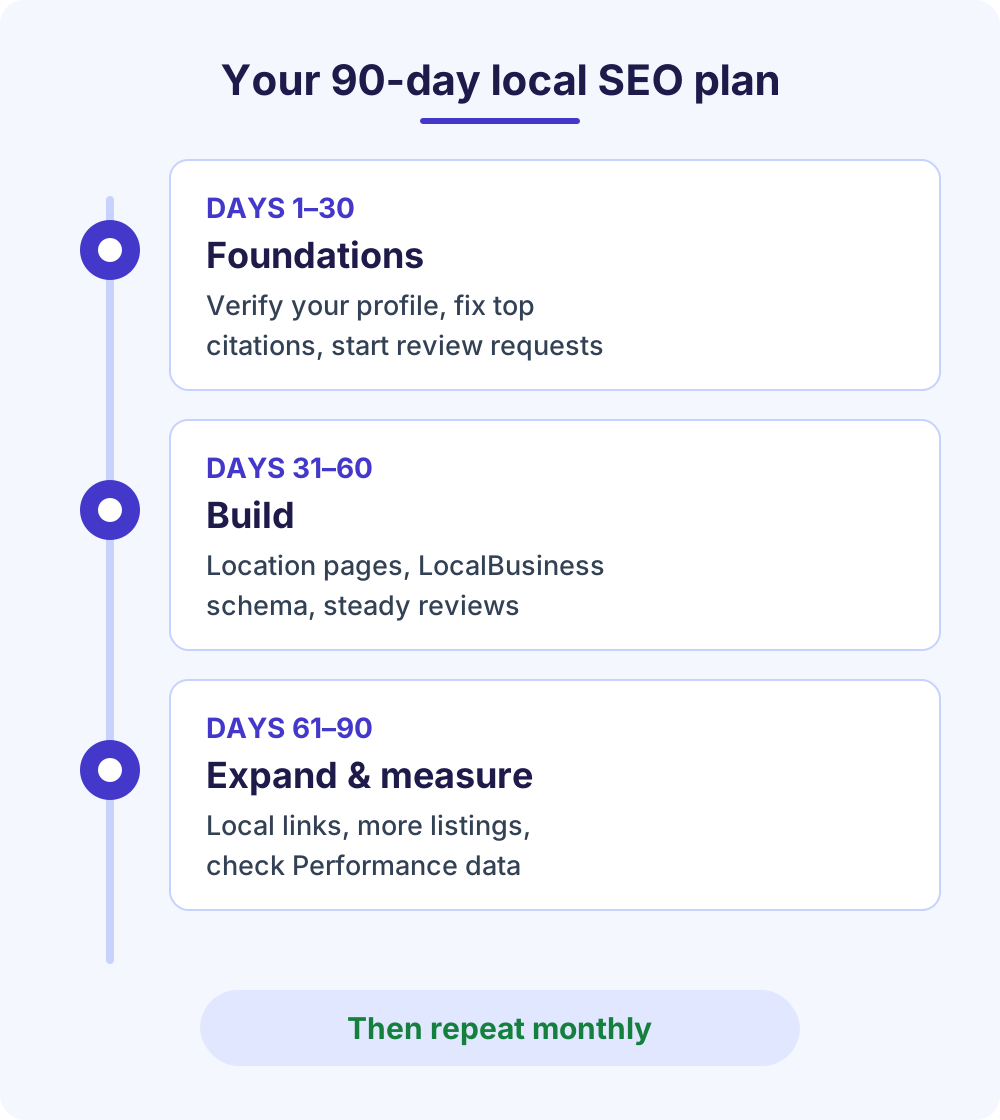
- Days 1 to 30, foundations: claim, verify and complete your Business Profile, correct your most important citations, and start asking every customer for a review.
- Days 31 to 60, build: publish two or three genuinely local pages, add LocalBusiness schema, and keep review requests steady.
- Days 61 to 90, expand and measure: add secondary directories, pursue local links, and compare Performance and Search Console data with your starting point.
Gains build when the work continues. Review requests, fresh photos and new local links keep strengthening prominence long after the first 90 days, so plan local SEO as an ongoing monthly routine.

How to measure whether it’s working
Track business outcomes, not just positions. Your Business Profile’s Performance view shows searches, views, calls, direction requests, website clicks, messages and bookings; open your profile on Google Search and select Performance.
Pair that with Google Search Console for the searches that bring people to your website, and a rank tracker set to your service area. Geo-grid rank trackers, which several local SEO tools offer, show how your map position changes from one side of town to the other. A good local SEO agency reports all of this monthly, next to the work it did.
Common local SEO mistakes small businesses make
Most problems with local SEO for small business come from neglect, not complex technical issues. Watch for these:
- Treating it as a one-time setup. A profile nobody updates or replies on loses ground to competitors who stay active.
- Forgetting old listings after a move or a phone change, which leaves conflicting NAP data across the web. A quarterly citation check catches this.
- Trying to rank one homepage for every town instead of building real location pages.
Frequently Asked Questions
How much do local SEO services cost for a small business?
It depends on your locations, competition and scope. BrightLocal’s 2020 industry survey found agencies averaged $127 an hour and freelancers $102, while consultants working alone averaged $766 per client per month. Most providers bill a monthly retainer, so ask each one for a written list of deliverables and compare quotes like for like.
Is a local SEO agency worth it for a small business?
It can be if you lack time, compete in a crowded category or run several locations. With one location in a quiet market, do the free basics first: verify your Google Business Profile, fix your citations and ask every customer for a review. Hire help when you can no longer keep that work up consistently on your own.
Can I do local SEO for my small business myself?
Yes. Most local SEO for small business is Google Business Profile updates, citation cleanup and review requests, which need time more than special tools. Expect a few hours a week during setup, then less for upkeep. Work from a checklist, keep your name, address and phone identical everywhere, reply to every review, and track calls and direction requests each month.
How long does local SEO take to work?
Google doesn’t publish a timeline, and no honest provider can promise one. As a planning guide, expect profile and citation fixes to show up as more views and calls within weeks, and stronger map-pack rankings in competitive areas over several months. Results keep building as reviews, links and useful local content accumulate.
Should I hire a local SEO company or a freelancer?
A freelancer suits one or two locations with a clear scope and a modest budget. A local SEO company suits multiple locations, competitive markets or projects that also need web development and content. Either way, check their process, references and contract terms, and keep ownership of your Business Profile, website and analytics accounts.
Can a local SEO agency guarantee a top spot on Google Maps?
No. Google states that no one can guarantee a #1 ranking and that there is no way to request or pay for a better local ranking. Results also depend on each searcher’s distance from you. Treat any guarantee as a red flag, and ask for measurable goals such as calls, direction requests and website clicks instead.
Do I need a physical address for local SEO?
No. Service-area businesses that visit customers, such as plumbers or cleaners, can hide their address in Google Business Profile and set the areas they serve instead. Google’s guidelines say a service area should generally stay within about two hours’ drive of your base. P.O. boxes and virtual offices aren’t eligible as addresses.
Does local SEO work for a new business or startup?
Yes, as long as you serve customers in person, at your premises or theirs. A new business starts with few reviews and links, so focus on a verified, complete profile, consistent citations and a steady review process from your first customers. Expect slower early gains than competitors with years of reviews behind them.
Next steps
Start with the do-it-yourself list above this week, then decide whether you need ongoing help. If you’d rather have a team handle it, see what our SEO, GEO and technical SEO service includes; local SEO is part of it.
Want us to do this for you?
We run SEO for small and mid-sized businesses: technical fixes, content and local SEO, reported in plain English.