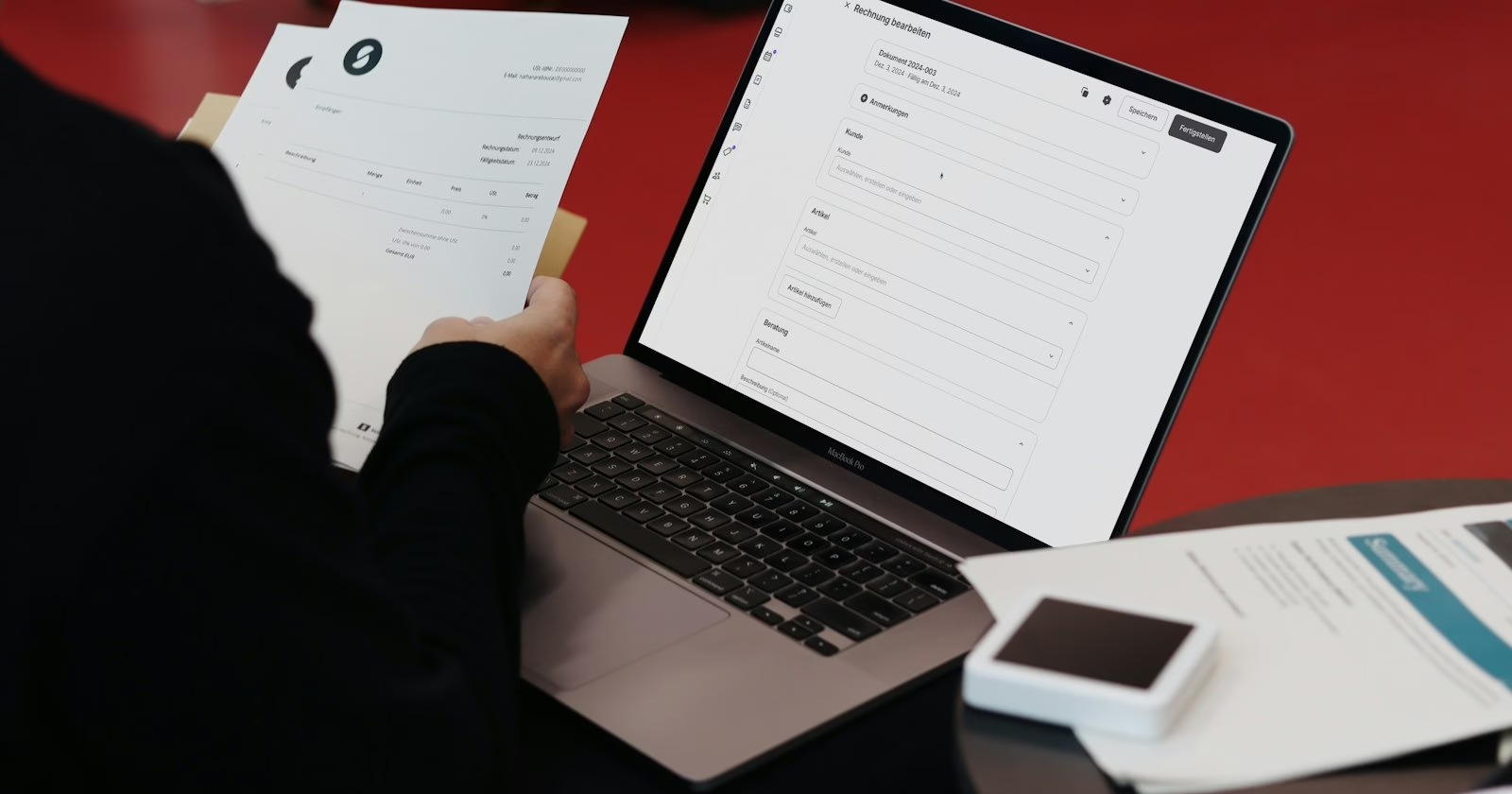
This guide shows you how to invoice as a freelancer, from agreeing terms to getting paid. It’s for designers, writers, developers, photographers and anyone self-employed who bills clients directly. You’ll learn how to write an invoice line by line, the extra rules in the UK, US and EU, payment terms and reminder wording, with two worked examples and a free freelance invoice template you can use without signing up.
How to invoice as a freelancer
To invoice as a freelancer, agree your rate and payment terms first, then send the client a numbered invoice that shows your details and theirs, the invoice date, an itemized list of the work with rates, any tax you’re registered to charge, the total due, a firm due date and how to pay. Send it as a PDF, keep a copy, and follow up on the due date if it’s unpaid.
In this guide
Here’s how to invoice as a freelancer in seven steps, whether you bill by the hour or by the project. A checklist of what to include on an invoice and the rules for the UK, US and EU follow the steps.
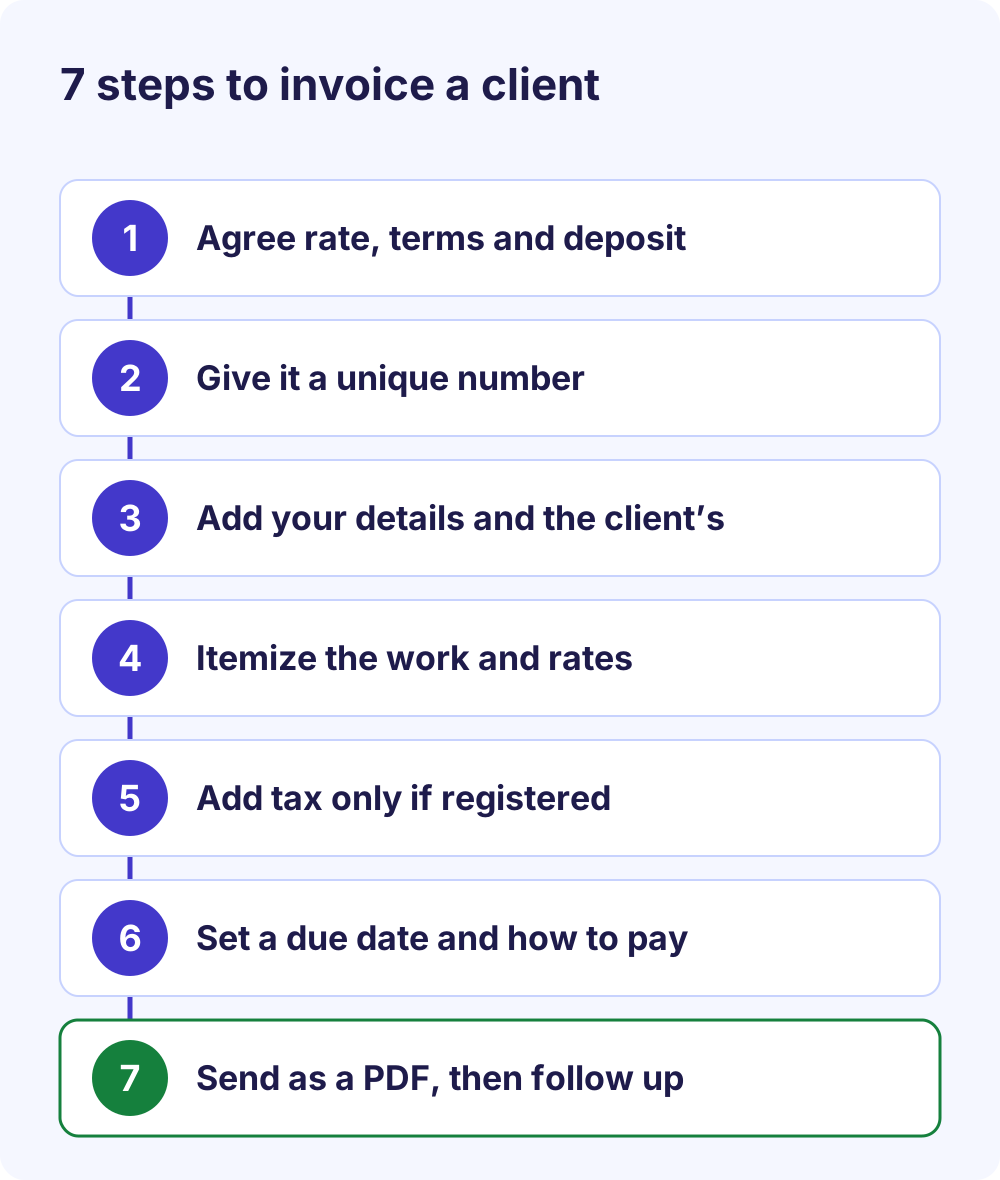
1. Agree your rate and payment terms before you start
Most invoicing problems start before the work does. Confirm in writing, even by email, how you’ll charge (hourly, daily or a fixed fee), when you’ll invoice, how many days the client has to pay, and whether you need a deposit. An invoice that matches what was agreed gets approved without back-and-forth.
For fixed-price work, send a quote first. Our generator’s free quotation mode converts an accepted quote into an invoice with the next number.
2. Give the invoice a unique number
Use a sequence that never repeats, such as INV-0001, INV-0002. Unique numbers let you match payments to invoices, and the UK government puts a unique identification number first on its list of what an invoice must include. Start from our freelance invoice template and the generator suggests the next number for you; the numbering schemes below cover other formats.
3. Add your details and your client’s
Put your name or business name, address, email and logo at the top, then the client’s company name and billing address. To invoice a company for freelance work, ask who handles accounts payable and whether they need a purchase order (PO) number; the person who hired you often isn’t the one who pays.
Our free letterhead maker keeps the logo and contact block on your invoices and letters consistent.
4. Describe the work line by line
Each line should say what you delivered in words your client will recognize. “Design work” invites questions; “Homepage and 3 inner page designs, 2 revision rounds” doesn’t. List the hours per task for hourly work, or the deliverable or milestone for a fixed fee.
Put pass-through expenses such as stock photos or travel on separate lines, and add the dates the work was done.
5. Add tax only if it applies to you
Whether you charge sales tax, VAT or GST depends on where you and your client are based, what you sell, and whether you’re registered. If you aren’t registered, don’t add tax; if you are, show the rate, the amount and your registration number. Our generator can also check an EU client’s VAT number with a live VIES lookup.
6. Set a due date and make paying easy
Write an actual due date, not just “Net 30”, and include your bank details or a payment link. Our generator turns a payment link, such as a PayPal.Me, Stripe or Wise page, into a scannable QR code on the PDF.
7. Send it as a PDF, keep a copy and follow up
Send a PDF so the layout can’t shift, with a clear subject such as “Invoice INV-0042 from Your Name, due November 17”. Save it with the invoice number in the file name and put the due date in your calendar. If a client asks for an e-invoice, our generator exports UBL 2.1 XML in the Peppol BIS Billing 3.0 format.
Billing several jobs in one email? Combine the invoices into one file with our free Merge PDF tool, or pull one invoice out of a combined file with Split PDF. If the file is too large for the client’s inbox, compress the PDF first. All three run in your browser, so your invoices aren’t uploaded anywhere.
What to include on an invoice
An invoice should let the client approve and pay it without asking a single question. Whether you’re a freelancer, a contractor or a small business, what to include on an invoice is largely the same:
- The word “Invoice” and a unique invoice number.
- Your name or business name, address and contact details.
- Your client’s name or company and billing address, plus a PO number if they use them.
- The invoice date and the date the work was done or delivered.
- An itemized description with quantities, rates and line totals.
- The subtotal, any discount and any tax, then the total due.
- The due date, written as an actual date.
- How to pay you: bank details, a payment link or accepted methods.
- Your tax or VAT number, if you’re registered for one.
- Any late-payment terms you agreed, such as a late fee.
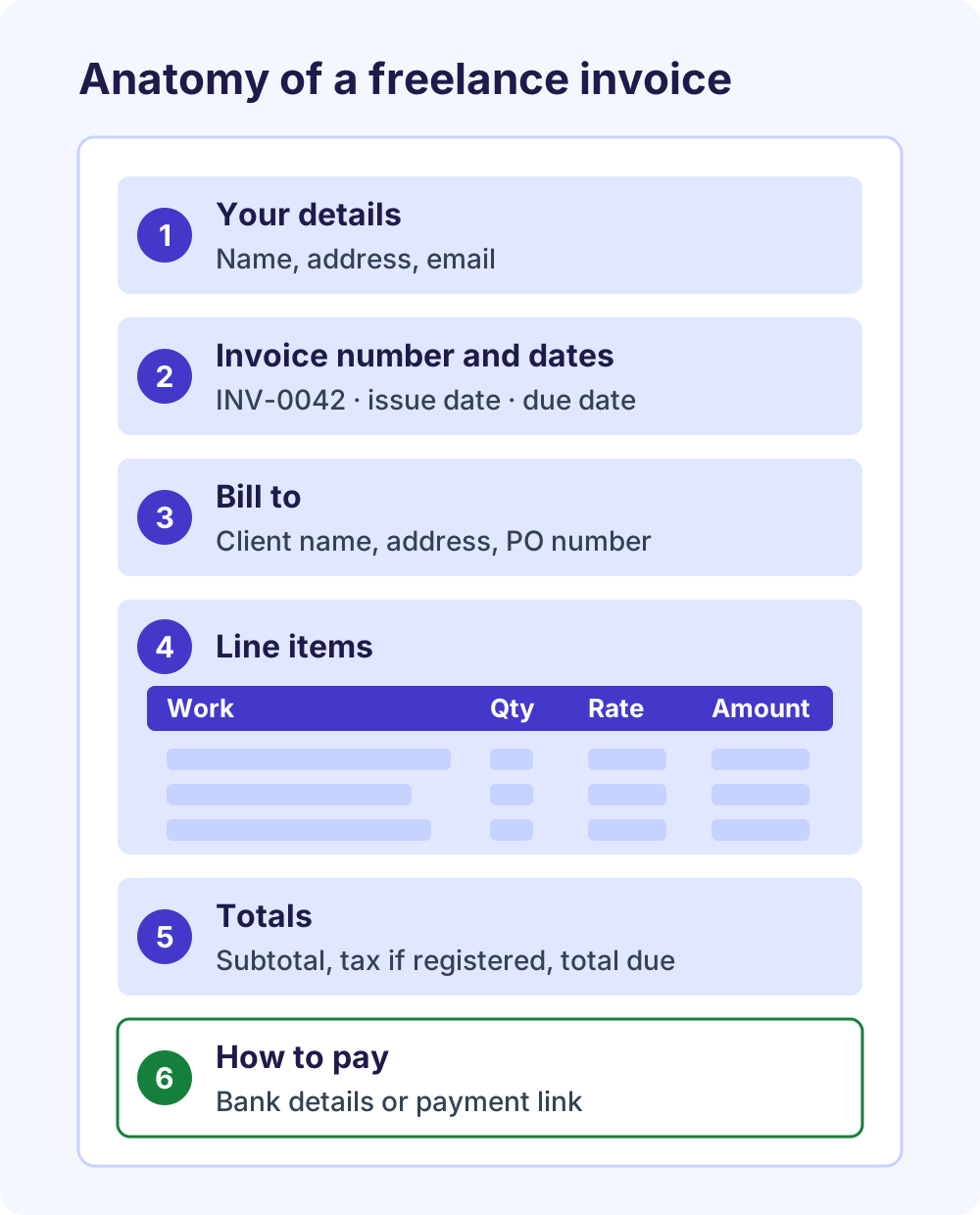
That checklist is also the short answer to how to write an invoice if you’re self-employed in any field. Our freelance invoice template lays these out for you, and trade jobs that add labor, materials and progress billing are covered in our contractor invoice template guide.
Invoice rules in the UK, US and EU
How to invoice as a freelancer barely changes between countries, because tax authorities broadly agree on what to include on an invoice. Here’s what each region adds, as of October 2026; it’s general information, not legal or tax advice.
United Kingdom
The UK government’s guidance on what to include on an invoice matches the checklist above, including the supply date and VAT if applicable. Sole traders must show their own name and any business name, plus an address for legal documents if they use a business name. Limited companies must use their full registered name. If you and your customer are both VAT-registered, you must issue a VAT invoice.
United States
There’s no single federal invoice format. The IRS says that, except in a few cases, the law doesn’t require any special kind of records, and you can choose any system that clearly shows your income and expenses. It lists invoices among the records that support your gross receipts, so keep a copy of each one. Business clients often ask for Form W-9, which gives them your taxpayer identification number, and sales tax on services varies by state.
European Union
If you’re VAT-registered in an EU country, the European Commission’s VAT invoicing rules say a full VAT invoice must show:
- The date of issue and a unique sequential number.
- Your full name and address, and the customer’s.
- Your VAT number, plus the customer’s if they are liable for the VAT.
- The service, quantity and unit price excluding VAT.
- The supply date, if it differs from the invoice date.
- The VAT rate and amount, broken down by rate.
If the customer accounts for the VAT under the reverse charge, the invoice must say “reverse charge”. Member States can add national rules.
Invoicing clients in another country
How to write an invoice for a client abroad comes down to removing ambiguity. Agree the currency and who pays transfer fees, show the currency on every amount, and write the month as a word, because 02/11 means different dates in the US and Europe. Our generator offers 35 currencies and 14 document languages.
Invoice numbering schemes
Any scheme works as long as every number is unique and follows a sequence you can explain. Pick one and stick with it:
| Scheme | Example | Works well when |
|---|---|---|
| Simple sequence | INV-0001, INV-0002 | You’re starting out |
| Year plus sequence | 2026-001, 2026-002 | You want each year grouped together |
| Client code plus sequence | ACME-001, ACME-002 | You bill several repeat clients |
| Date-based | 20261102-01 | You send several invoices a day |
| Separate quote series | QUO-0007, then INV-0042 | Your quotes become invoices |
Never reuse or delete a number. If a sent invoice is wrong, issue a credit note that refers to the original number, then a corrected invoice with a new one; EU rules require that reference on credit notes.
How to write an invoice for freelance work (2 examples)
The quickest way to learn how to write an invoice for freelance work is to copy a finished one. Below are two worked examples, one hourly and one at a fixed project price with a deposit. Names and prices are illustrative.
Hourly freelance invoice example
This shows how to write an invoice for hourly work. A freelance copywriter bills October’s work on Net 15 terms: invoice INV-0042, dated November 2, 2026. The writer isn’t registered for sales tax or VAT, so the tax line is zero.
| Description | Hours | Rate | Amount |
|---|---|---|---|
| Blog articles: research and writing, 4 posts (Oct 3–24) | 12.5 | $65 | $812.50 |
| Editing client-supplied drafts (Oct 10–28) | 6 | $65 | $390.00 |
| Content planning call (Oct 7) | 1.5 | $65 | $97.50 |
| Subtotal | $1,300.00 | ||
| Tax (not registered) | $0.00 | ||
| Total due by November 17, 2026 | $1,300.00 | ||
Each line names the task and the dates, so the client can check it against their records, and your timesheet backs up any entry they question.
Project freelance invoice example with a deposit
A freelance web designer charges a fixed $2,400 for a small website, with 50% paid upfront on a separate deposit invoice, plus one extra revision round the client approved by email. Final invoice INV-0057 is dated November 20, 2026, on Net 7 terms.
| Description | Qty | Rate | Amount |
|---|---|---|---|
| Website design: homepage and 3 inner pages (fixed fee, per quote QUO-0007) | 1 | $2,400.00 | $2,400.00 |
| Extra revision round approved by email on Nov 4 (hours) | 3 | $60.00 | $180.00 |
| Stock photo licenses, at cost | 3 | $15.00 | $45.00 |
| Subtotal | $2,625.00 | ||
| Less deposit received (INV-0049, paid Oct 1) | −$1,200.00 | ||
| Balance due by November 27, 2026 | $1,425.00 | ||
The deposit appears as a payment, not a discount, so the full project value stays visible. In our freelance invoice template, enter the deposit in the Amount Paid field and the balance due updates for you.
Hourly vs project billing: which should you use?
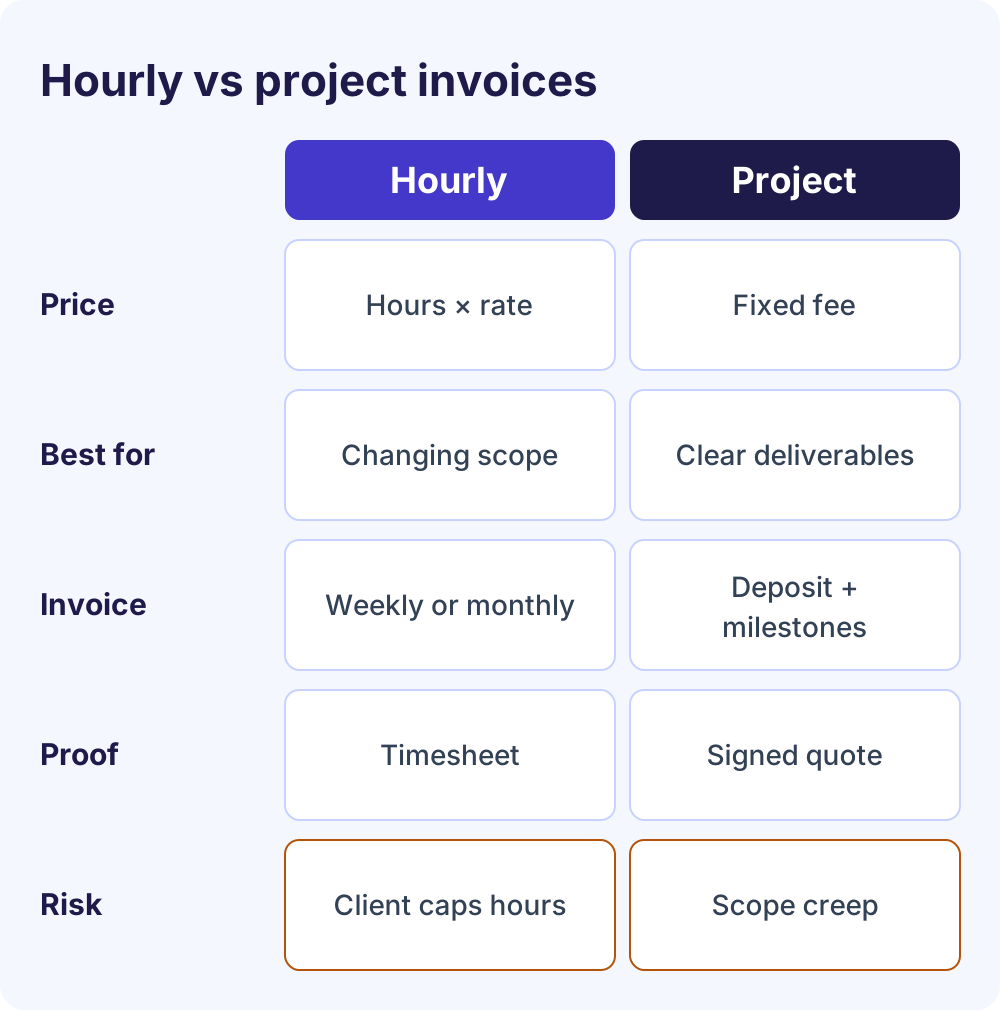
Bill hourly when the scope is likely to change, and charge a fixed project fee when the deliverables are clear. Many freelancers combine both, as the project example does.
Either way, you don’t have to build the layout from scratch. Open the freelance invoice template in our generator, replace the sample lines with your own, and download the PDF.
Payment terms: Net 15, Net 30 or due on receipt?
Payment terms are the part of how to invoice as a freelancer that most affects your cash flow. “Net 30” means payment is due 30 days after the invoice date; “due on receipt” means pay now. Large companies often insist on longer terms.
| Term | What it means | Good fit for |
|---|---|---|
| Due on receipt | Pay when the invoice arrives | Small jobs and final balances |
| Net 7 | Due 7 days after the invoice date | New clients, short projects |
| Net 15 | Due 15 days after the invoice date | Most ongoing freelance work |
| Net 30 | Due 30 days after the invoice date | Companies with monthly payment runs |
| 50% upfront, 50% on delivery | Half before you start, half at handover | Fixed-price projects |
Agree the terms before you start and print the actual due date. In the UK, the government’s late commercial payments guidance says agreed periods must usually be within 60 days for business transactions (30 for public authorities). If no date was agreed, payment is late 30 days after the customer receives the invoice or you deliver the work, whichever is later.
Deposits, retainers and milestone payments
Ask for a deposit when a project is large or the client is new. A deposit invoice is a normal invoice with its own number, and the final invoice subtracts it.
- Deposit: many freelancers ask for 25% to 50% upfront, invoiced separately, and start once it’s paid.
- Milestones: split longer projects by stage, such as 40% at kickoff, 40% at design approval and 20% at launch, and name the stage on each invoice.
- Retainer: invoice at the start of each month and bill extra hours on the next invoice.
- Kill fee: agree in writing what the client pays if they cancel partway through.
Say in your contract or quote whether the deposit is refundable; it can save an argument if a project is cancelled.
What to do when a client pays late
Most late payments come down to a missing detail or a busy inbox. Follow a polite sequence that gets firmer over time, keep it in writing, and only add fees your contract or the law allows.
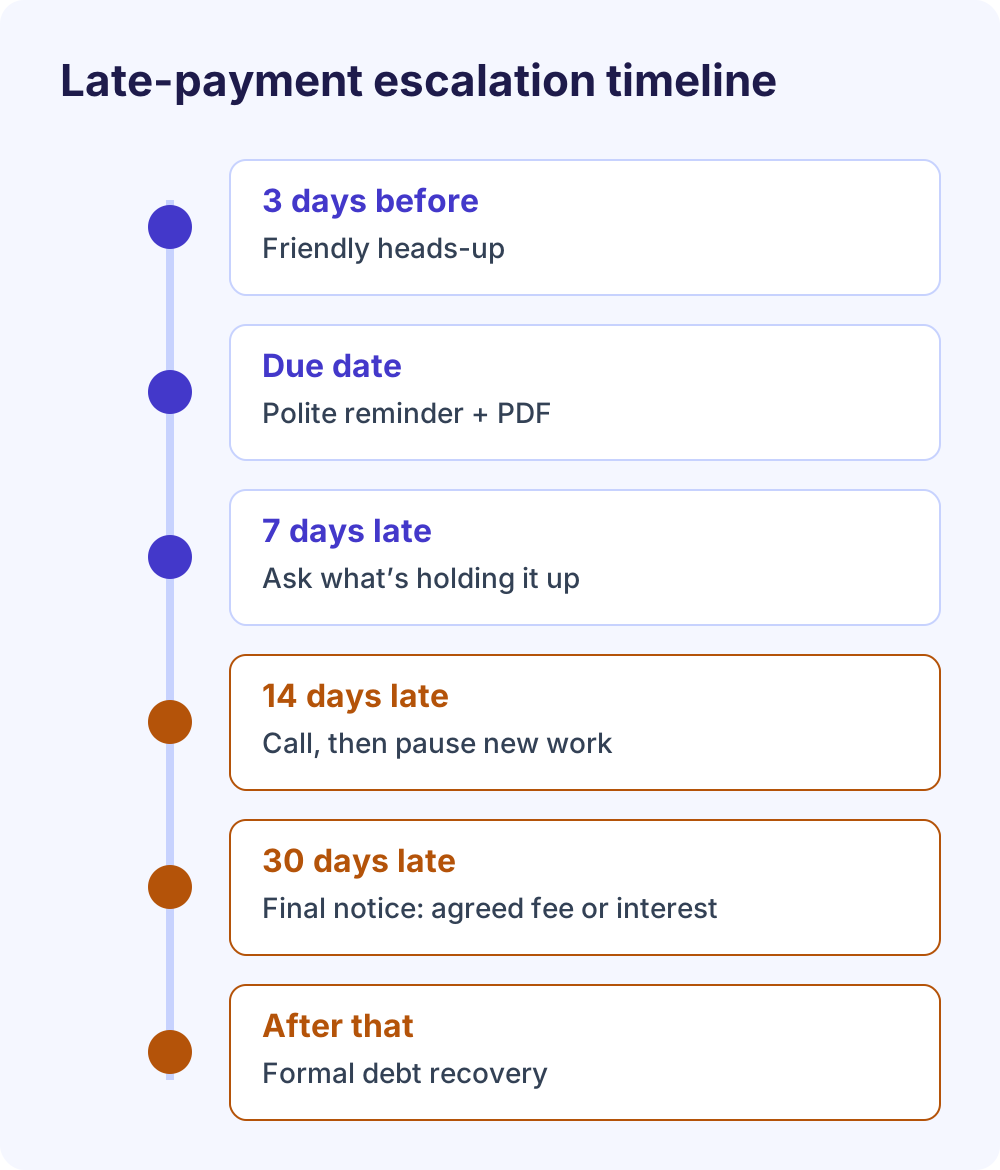
| When | Send | Sample wording |
|---|---|---|
| 3 days before | Heads-up | “Hi Sam, a quick note that invoice INV-0057 for $1,425.00 is due on November 27. The PDF is attached again. Thanks!” |
| Due date | Reminder | “Hi Sam, invoice INV-0057 is due today. You can pay by bank transfer or with the payment link on the invoice.” |
| 7 days late | Ask what’s blocking it | “Invoice INV-0057 is now 7 days overdue. Is anything holding it up, such as a missing PO number?” |
| 14 days late | Call, then confirm in writing | “As discussed, I’ll pause new work from Friday until the balance is paid, as our agreement allows.” |
| 30 days late | Final notice | “If payment isn’t received by [date], I’ll add the agreed late fee and start formal recovery.” |
Late fees and statutory interest
In the UK, if another business pays late you can usually claim statutory interest of 8% plus the Bank of England base rate, plus fixed recovery costs of £40 (debts up to £999.99), £70 (£1,000 to £9,999.99) or £100 (£10,000 or more). You can’t claim it if your contract sets a different rate. A Commercial Payments Bill that would cap payment terms at 60 days was still before Parliament in October 2026, so check gov.uk for changes.
In the EU, you can charge the interest in your contract or, failing that, the country’s statutory rate, plus a flat €40 per late invoice, according to Your Europe. In the US, late fees mostly depend on your contract and state law, so put any fee in writing before work starts.
Common freelance invoicing mistakes
Even once you know how to invoice as a freelancer, these slips give clients a reason to put your invoice aside:
- Vague descriptions that make the client ask what they’re paying for.
- No due date, which quietly turns “pay soon” into “pay eventually”.
- The wrong recipient, or a missing PO number.
- Reusing or deleting invoice numbers instead of issuing a credit note.
- Charging VAT or sales tax when you aren’t registered.
- Missing payment details, so the client has to write back before paying.
- Waiting weeks to invoice after the work is finished.
Good records make tax time easier. Total what you invoiced and spent each month, and our free profit and loss statement generator turns those totals into a simple P&L for your accountant.
Frequently Asked Questions
How do I write an invoice for freelance work?
Here’s how to write an invoice for freelance work in short: add your details and the client’s, a unique number, the invoice date and a due date. List each piece of work with its hours or quantity, rate and total, add tax only if you’re registered, and show the total due and how to pay.
How do I invoice a company for freelance work?
Ask your contact who handles accounts payable, where to email invoices, and whether you need a purchase order number or supplier form first. US companies often ask for Form W-9 before the first payment. Quote the PO number and project name so the finance team can match your invoice quickly.
Can I invoice clients without a registered business?
In many countries, yes: you can usually invoice under your own name as a sole proprietor or sole trader. In the UK, if you use a business name you must also show your own name and an address for legal documents. You may still need to register with your tax authority once you start earning.
Is there a free freelance invoice template?
Yes. Our invoice generator includes a free freelance invoice template you can edit in your browser. Add your logo, rates and payment link, then download a PDF. There’s no sign-up, and your invoices are saved in your own browser so you can reuse your details next time.
What payment terms should freelancers use?
Many freelancers use Net 15 or Net 30, meaning payment is due 15 or 30 days after the invoice date. Due on receipt suits small jobs, final balances and new clients. Whatever you choose, agree it before you start, write the exact due date on the invoice, and take a deposit on larger projects.
Can I charge a late fee on a freelance invoice?
Often, yes, and a fee agreed in advance is the safest basis. In the UK, businesses that pay late can owe statutory interest of 8% plus the Bank of England base rate and £40 to £100 in fixed costs, unless your contract sets its own rate. EU rules add a flat €40 per late business invoice. In the US, it depends on your contract and state law.
Next steps: create your first freelance invoice
You now know how to invoice as a freelancer. Open our free invoice generator, pick the freelance invoice template, and send your first PDF today. Prefer to work in Google Docs? Copy our free invoice template for Google Docs, which has a freelance layout with separate hourly and fixed-price tables. Still finding clients? Our WordPress portfolio website examples show how to present the work you’ll bill for.
Create your first freelance invoice now
Add your logo and details, list your work, and download a professional PDF in a few minutes. Free, no sign-up.
Open the free invoice generator