The biggest SEO trends of 2026 are AI answers taking clicks, Google’s demand for original first-hand content, new reports that measure AI visibility, and tougher spam rules. Google says optimizing for AI is still SEO, so small sites should focus on crawlable pages, real expertise and honest measurement, and skip tricks such as llms.txt or mass-produced AI pages.
Most SEO trends 2026 lists repeat the same predictions. This one is different in two ways. Every point below comes from a primary source, mainly Google’s own guide, its update history and published research, as we checked them in November 2026. It also tells you what to ignore, which matters more when you run a small website with limited time.
In this guide
Key Takeaways
- AI summaries reduce clicks: in Pew’s study, people clicked a result on 8% of visits with an AI summary and 15% without one.
- Google calls GEO and AEO the same work as SEO, and its guide lists tactics you don’t need.
- Original, first-hand content is the clearest way to stand out from pages that say the same thing.
- You can now measure AI visibility in Search Console and Bing Webmaster Tools.
- Google’s spam policies apply to generative AI responses in Search, so mass-produced pages are a risk.
What changed in Google Search in 2026?
Before the SEO trends themselves, here’s what actually happened this year. The Google Search Status Dashboard lists two core updates and four spam updates up to early November, and the Search Central blog added new guidance and reports.
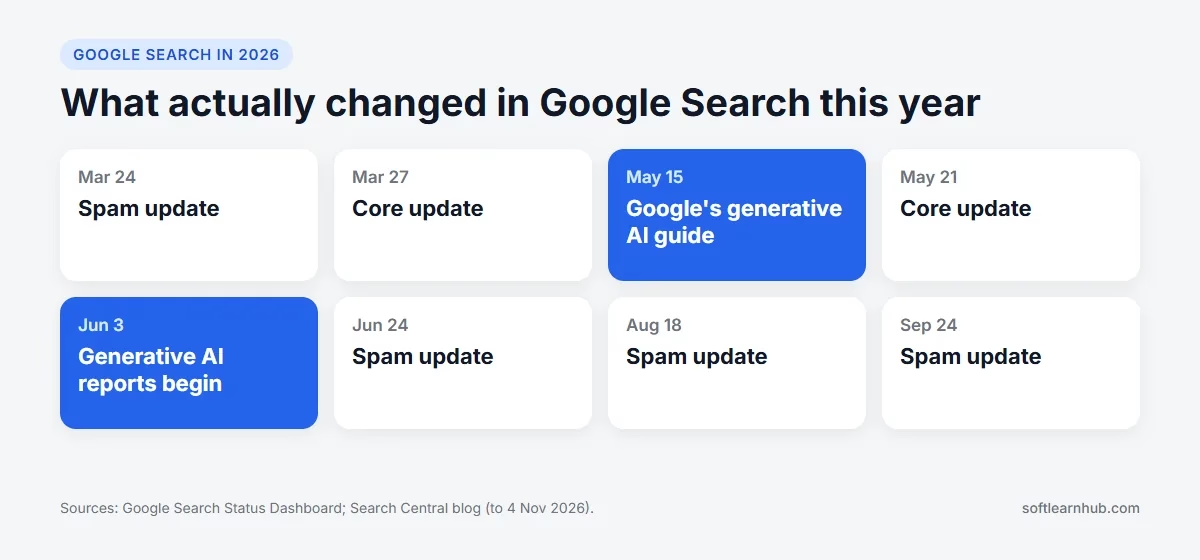
Spam updates came twice as often as core updates this year, which tells you where Google’s attention has been. If your traffic moved sharply around one of these dates, check it against the dashboard before you change anything. We recommend waiting until a rollout has finished before you judge the results.
SEO trend 1: AI answers are taking clicks
This is the trend every site owner feels. Pew Research Center tracked the browsing of 900 US adults in March 2025 and compared Google searches with and without an AI summary.
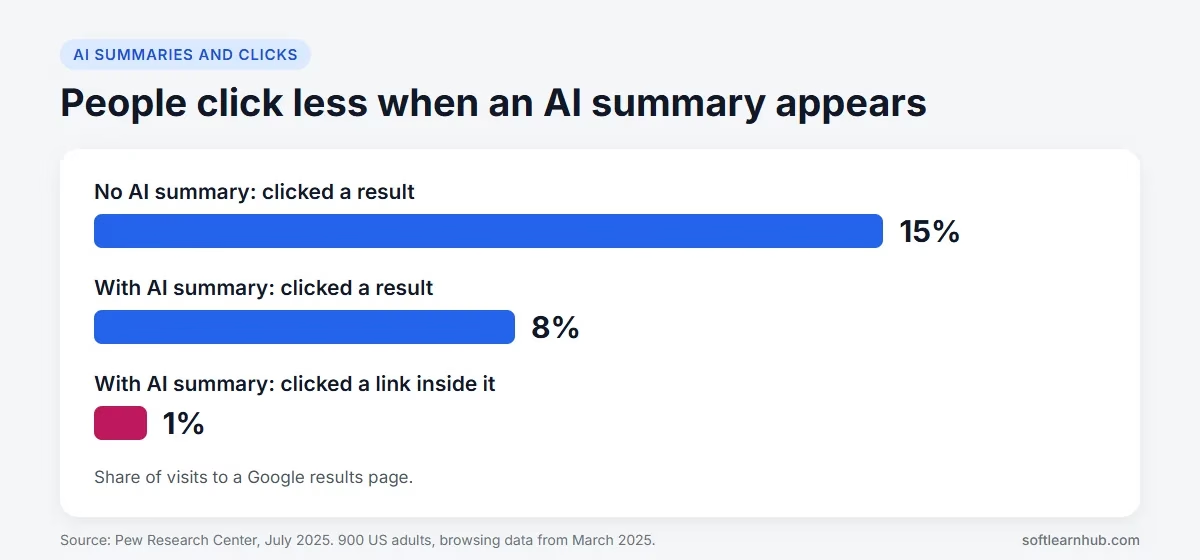
People clicked a traditional result on 8% of visits when an AI summary appeared and 15% when it didn’t. Only 1% of visits to those pages included a click on a link inside the summary. The data is from 2025, so treat it as a direction rather than today’s exact figure.
What to do: stop judging content by clicks alone. Some pages now earn their value by being seen and cited. Our generative engine optimization guide explains how to become one of the sources an AI answer links to.
SEO trend 2: GEO is still SEO
Every 2026 trend list mentions GEO or AEO. Google’s position, published in May, is that these are names for the same work it calls SEO, because its AI features rely on its core ranking and quality systems. They retrieve pages from the Search index first, then write an answer.
For a small site that’s reassuring. A page has to be indexed and eligible to show a snippet to appear as a supporting link, so the basics in our technical SEO guide are also your AI search foundation. If your pages aren’t indexed at all, start with why a website doesn’t show up on Google.
SEO trend 3: Non-commodity content wins
Google’s guide asks for “non-commodity” content: a unique point of view, plus first-hand or expert experience. Anyone can publish a generic list of tips, and AI can write one in seconds. That’s why it’s worth less each year.
Here’s what counts as non-commodity in practice:
- A test you ran, with your own numbers.
- A real mistake and what fixed it.
- Prices you actually paid, or a comparison you made yourself.
- A tool or template that solves the problem directly.
We saw this on our own site. When we asked Perplexity 21 questions our pages answer, one of the two times we were cited was for a free tool that does something specific. A working tool can’t be swapped for another generic article. Our content marketing strategy framework shows how to plan this kind of work.
SEO trend 4: You can finally measure AI visibility
This is the most useful change of the year, and most trend posts barely mention it.
- Google: in June, Search Console added generative AI performance reports. They show impressions in features such as AI Overviews and AI Mode by page, country, device and date. Google says they reached all websites by 31 August.
- Bing: the AI Performance report shows citations across Copilot, Bing AI summaries and select partners. A June update added intents, topics, citation share and period comparison. Our Bing Webmaster Tools guide covers the setup.
- Your analytics: check referrals from AI assistants in GA4. Between 30 September and 27 October 2026 we recorded 63 sessions from AI assistants against 29 from organic search, which we’d never have known from rankings alone.
Google also warns that no third-party tool has access to its internal ranking or AI systems, so treat outside “AI visibility scores” as estimates.
SEO trend 5: Spam rules now reach AI answers
On 15 May, Google clarified that its spam policies apply to generative AI responses in Search. Those policies include scaled content abuse: many pages generated mainly to manipulate rankings, for example with AI tools that add no value. Google’s guide also warns against creating a page for every query variation to influence AI responses.
Other changes this year include a new back button hijacking policy in April. Using AI to help you write is fine; publishing at scale without adding anything isn’t. Before you publish, ask what a reader gets here that they can’t get elsewhere.
SEO trend 6: Rich results keep shrinking
Google’s documentation updates show FAQ rich results no longer appear in Search, with a May 2026 notice and the documentation removed in June. That follows the removal of practice problem documentation in January.
Structured data still has a job. It helps with the rich results that remain and describes your business accurately, but Google says it isn’t required for generative AI features and there’s no special markup to add. Keep your markup honest and matched to the page, and check it with our free schema validator. If Search Console shows problems, see our guide to fixing structured data errors.
SEO trend 7: Control over AI use is becoming clearer
Site owners are getting more say over how their content is used, but the controls do different jobs. Google-Extended affects training and grounding in some of Google’s other AI systems. OpenAI separates OAI-SearchBot, which powers ChatGPT search, from GPTBot, which is for training. Blocking the wrong one can remove you from an answer engine.
On 30 October, Google said it plans to support a shared AI training control in robots.txt, aiming for 2027. There’s nothing to do yet, but watch for it if you care about training use. For now, check that your robots.txt and your CDN aren’t blocking search crawlers by accident.
SEO trend 8: Reputation beyond your own website
Google’s guide says seeking inauthentic mentions isn’t as helpful as it seems, because core systems favour quality and spam systems block manipulation. So the trend is genuine reputation, not manufactured buzz.
Reviews, real customers, useful data that others quote and listings where your audience already looks all count. Google also added a preferred sources feature this year, which is another reason to give regular readers a reason to come back. Our guide to what backlinks are explains why earned links still matter.
SEO trend 9: AI search is also becoming a paid channel
Organic citations aren’t the only way in. ChatGPT now sells ads that sit apart from its answers, and OpenAI states they don’t influence those answers. For most small businesses this isn’t a priority yet, but it’s worth knowing the difference. Our guide on how to advertise on ChatGPT covers who can buy them.
Which SEO trends should a small business ignore?
The most helpful list for a small site is the list of things to skip. Google’s guide has a mythbusting section, and it removes a lot of busywork.
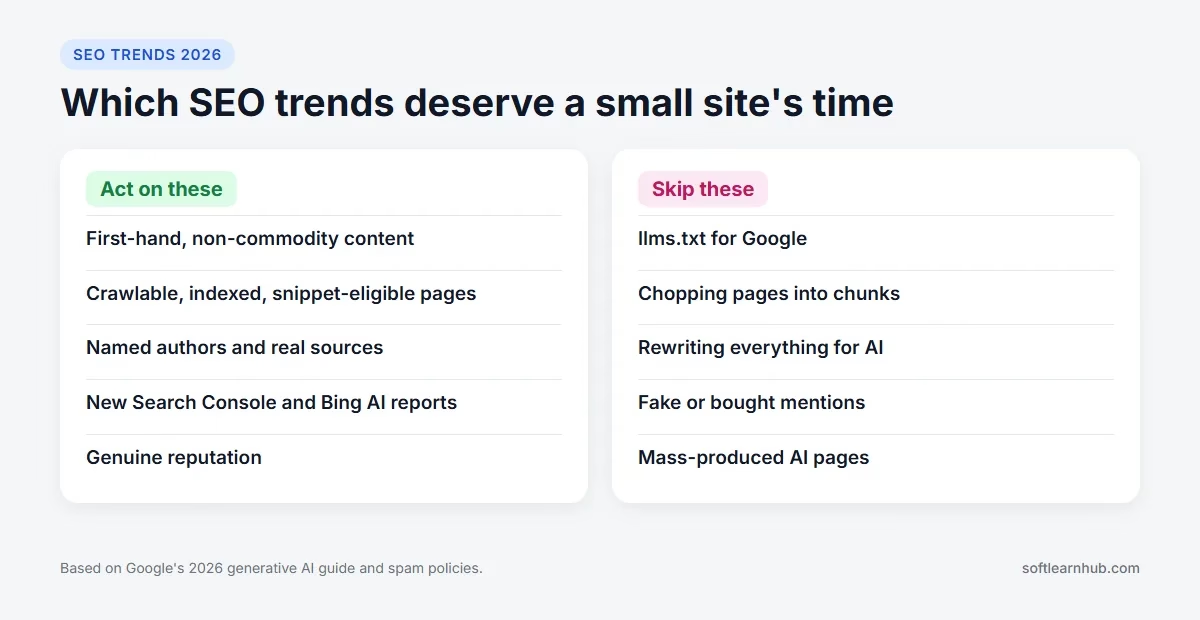
| Popular advice | What Google says | Our advice |
|---|---|---|
| Add an llms.txt file | Google Search doesn’t use it; it won’t help or harm there | Skip it for Google |
| Break content into small chunks | There’s no ideal page length | Write for readers |
| Rewrite pages for AI | AI systems understand synonyms and meaning | Don’t rewrite for this reason |
| Buy mentions | Inauthentic mentions aren’t as helpful as they seem | Earn real ones |
| Add special schema for AI | There’s no special markup to add | Use schema for its normal jobs |
How to act on SEO trends 2026 in 30 days
You don’t need a new strategy. You need a short list, done well.
- Week 1: check indexing in Search Console and make sure crawlers aren’t blocked by robots.txt or your CDN.
- Week 2: pick your 10 most important pages and add a direct answer near the top of each.
- Week 3: add one piece of first-hand evidence to each page, such as a test, a number or a real example.
- Week 4: open the generative AI reports in Search Console and Bing, note your baseline, and check again each month.
Want us to do this for you?
We run SEO for small and mid-sized businesses: technical fixes, content and local SEO, reported in plain English.
See our SEO servicesFrequently Asked Questions
What are the latest SEO trends in 2026?
The main SEO trends are AI answers reducing clicks, Google’s focus on original first-hand content, new AI visibility reports in Search Console and Bing, and spam policies that now apply to generative AI responses.
Is SEO still worth it in 2026?
Yes. Google says its generative AI features are rooted in its core ranking and quality systems, so a page still has to be crawlable, indexed and useful. SEO is the foundation for appearing in AI answers too.
What is the difference between SEO and GEO?
Google treats them as the same work. GEO is the name for making content easy for AI search to find and cite, while SEO has long covered that foundation. What changes is how you measure the results.
Do I need an llms.txt file?
Not for Google. Google’s guide says Google Search doesn’t use it and that keeping one will neither harm nor help your visibility there.
How many core updates has Google released in 2026?
The Search Status Dashboard lists two core updates so far: March and May 2026. It also lists four spam updates and a February Discover update, as of early November 2026.
How can I see if my site appears in AI Overviews?
Use the generative AI performance reports in Search Console, which show impressions by page, country, device and date. For Copilot and Bing, use the AI Performance report in Bing Webmaster Tools.
Can I use AI to write content for SEO?
Yes, as long as it adds value. Google’s spam policies target pages generated at scale mainly to manipulate rankings, so add your own experience and check every fact before you publish.
Featured photo by Luke Chesser on Unsplash.