
The best ecommerce SEO company for your store is the one that fits your platform, catalog size and margins, not the one with the loudest sales deck. This guide is for store owners and marketing leads choosing a partner in 2026. You get nine established agencies checked against their own websites, a 100-point scorecard, published pricing data, a first-90-days plan and the red flags that should end a sales call.
Which is the best ecommerce SEO company for your store?
No single best ecommerce SEO company suits every store. The right agency has worked on your platform (Shopify, BigCommerce, Adobe Commerce or WooCommerce) and catalog size, reports organic revenue rather than rankings alone, and can explain how it will handle faceted navigation, product structured data and category pages. Shortlist three or four agencies, score them on the same criteria, and walk away from guaranteed rankings, which Google says no one can promise.
In this guide
How this guide was built: every agency detail below comes from that agency’s own website, checked in October 2026, and every Google recommendation links to the original Search Central page, so you can verify both yourself.
9 ecommerce SEO agencies to compare (checked October 2026)
These established agencies all publish ecommerce SEO services or an ecommerce practice. They’re listed alphabetically, not ranked, with no star ratings, results or client names, because we can’t verify those independently. Every detail comes from the agency’s own site, linked in each profile.
Disclosure: Soft Learn Hub also sells SEO, GEO and technical SEO services, so we compete with these firms. We left ourselves off this list on purpose, and none of the agency links are affiliate links.
| Agency | Base | Ecommerce focus | Platforms named | Published pricing |
|---|---|---|---|---|
| Found | London; New York | Ecommerce SEO service | Adobe Commerce, Shopify, WooCommerce | None |
| Go Up | London; Marina del Rey, CA | Shopify SEO (generalist agency) | Shopify | Bespoke quotes |
| Inflow | Remote; Tampa, FL | Ecommerce marketing | Shopify, BigCommerce, Magento, WooCommerce | $3,000–$5,000/mo guidance |
| NOVOS | London; Sheffield | Ecommerce growth | Shopify Plus, Magento, headless | None |
| OuterBox | Akron, OH; Houston; Tuscaloosa | Ecommerce and lead gen | Shopify Plus, BigCommerce, Adobe Commerce, WooCommerce | None |
| Re:signal | Remote; London, Manchester, LA | Ecommerce organic growth | Not named | None |
| The SEO Works | Sheffield | Generalist with ecommerce work | Magento, WordPress | On request |
| Victorious | San Francisco | SEO agency, ecommerce page | Shopify, BigCommerce, Magento, WooCommerce | Suggests $6,000+/mo |
| WebFX | Harrisburg, PA | Full-service, ecommerce plans | Shopify, BigCommerce, WooCommerce | From $2,900/mo |
Found
A London agency with a New York office that calls itself “AI-first.” Its ecommerce SEO services cover technical analysis for large URL sets, product and category pages, AI search visibility, content and digital PR, backed by its own Luminr visibility platform. It doesn’t publish prices. Source: Found ecommerce SEO page.
Go Up
A London-based search marketing and SEO agency with a second office in Marina del Rey, California. Its ecommerce offer is a Shopify SEO service: an audit, product descriptions and content, backlinks and app advice. Its pricing page says quotes are bespoke and contracts roll monthly. Source: Go Up Shopify SEO page.
Inflow
An ecommerce marketing agency whose press kit says it’s fully remote and based in Tampa, Florida. Its SEO page lists technical SEO, product and category optimization, link building, digital PR and migrations, and says effective SEO generally costs $3,000 to $5,000 a month, more for larger sites. Source: Inflow SEO services page.
NOVOS
An employee-owned ecommerce growth agency with offices in London and Sheffield. It says it began with Magento and headless specialists and that more than 70% of its clients now run on Shopify Plus. Services span technical SEO, content, migrations, digital PR, GEO and paid media. No price list is published. Source: NOVOS SEO page.
OuterBox
An agency with offices in Akron, Ohio; Houston, Texas; and Tuscaloosa, Alabama. Its ecommerce SEO services target complex catalogs: faceted navigation and canonical audits, category and product pages, and product schema covering price, availability, shipping, returns and variants. It says pricing depends on catalog size and complexity. Source: OuterBox ecommerce SEO page.
Re:signal
A remote ecommerce SEO agency (its site title reads “Global Ecommerce SEO & GEO Agency”) with offices in London, Manchester and Los Angeles. Services include technical SEO, content, digital PR, product data for Google Shopping and Amazon, and AI search. Its homepage names no platforms or prices. Source: Re:signal homepage.
The SEO Works
A Sheffield-based agency that describes itself as an integrated GEO and SEO agency. Ecommerce is one of several sectors it serves, and it publishes ecommerce case studies. Services include technical SEO, content, digital PR and Google Shopping management; its web team names Magento and WordPress. Quotes are on request. Source: The SEO Works SEO services.
Victorious
A San Francisco SEO agency whose ecommerce SEO services cover technical analysis, product pages, schema markup, content and link building, naming Shopify, BigCommerce, Magento and WooCommerce. There’s no price list, but its homepage FAQ recommends budgeting at least $6,000 a month and a 12-month campaign to start. Source: Victorious ecommerce SEO page.
WebFX
A full-service agency headquartered in Harrisburg, Pennsylvania, and one of the few that publishes ecommerce SEO services pricing: management starts at $2,900 a month, with tiers set by pages and keyphrases optimized. It mentions Shopify, BigCommerce and WooCommerce, plus Amazon, Walmart and Target marketplace support. Source: WebFX ecommerce SEO plans.
Plenty of capable specialists aren’t listed here. Use the scorecard below to judge any ecommerce SEO agency the same way, including the ones that pitch you directly.
What ecommerce SEO services include
Complete ecommerce SEO services cover six areas, from crawl control to digital PR. Google’s own SEO best practices for ecommerce sites are the baseline any proposal should match.
Technical SEO and crawl control
Stores generate far more URLs than blogs: sort orders, filters, parameters, variants and out-of-stock pages. Expect an audit of what gets crawled and indexed, fixes for duplicates and soft 404s, and speed work. Google’s crawl budget guide notes that soft 404s keep getting crawled and waste budget on very large or fast-changing sites. Our technical SEO basics guide covers sitemaps and crawl errors.
Out-of-stock handling is a good litmus test. Temporarily unavailable products usually stay live with updated availability, so they keep their backlinks and rankings. Discontinued items typically get a 301 to the closest replacement or category, or a 404 or 410 if nothing fits. Google treats permanent redirects as a canonical signal and 302s as temporary.
Category and product pages
Category pages target the commercial searches that sell, such as “waterproof hiking boots”, so they need unique copy and strong internal links. Product pages need original descriptions and accurate price and stock details. Google recommends linking menus to categories, categories to every product you want indexed, and the home page to your top sellers.
Faceted navigation and pagination
Filters for size, color and price can create near-infinite URL combinations. Google’s faceted navigation guidance suggests blocking filter URLs you don’t need in search with robots.txt, and calls canonical tags a weaker, slower signal. Paginated categories need their own URL and canonical per page; Google no longer uses rel=”next” and rel=”prev”.
Structured data for products
Product markup with price, availability and reviews can make listings eligible for richer results. Google’s product structured data documentation separates product snippets from merchant listings, which apply to pages where shoppers buy directly. Google also recommends BreadcrumbList and Organization markup. Our product schema markup guide shows the setup step by step.
Content that supports buying decisions
Buying guides and comparisons earn their place when they link into the categories they support. Seasonal pages need planning months ahead; our BFCM and ecommerce SEO guide explains why Black Friday pages should stay live year-round.
Digital PR and link building
Few people link to product pages, so agencies use digital PR: data stories, expert commentary and campaigns that earn coverage. Google’s spam policies treat buying or selling links for ranking purposes as link spam, so ask exactly how links are earned. Our guide to safe backlink building services lists the questions to ask a vendor.
How to evaluate an ecommerce SEO agency
Score every ecommerce SEO agency on the same six criteria, so a polished pitch can’t outweigh a weak plan. Weight platform fit, technical depth and revenue reporting most heavily, because they decide whether the work reaches your bottom line.
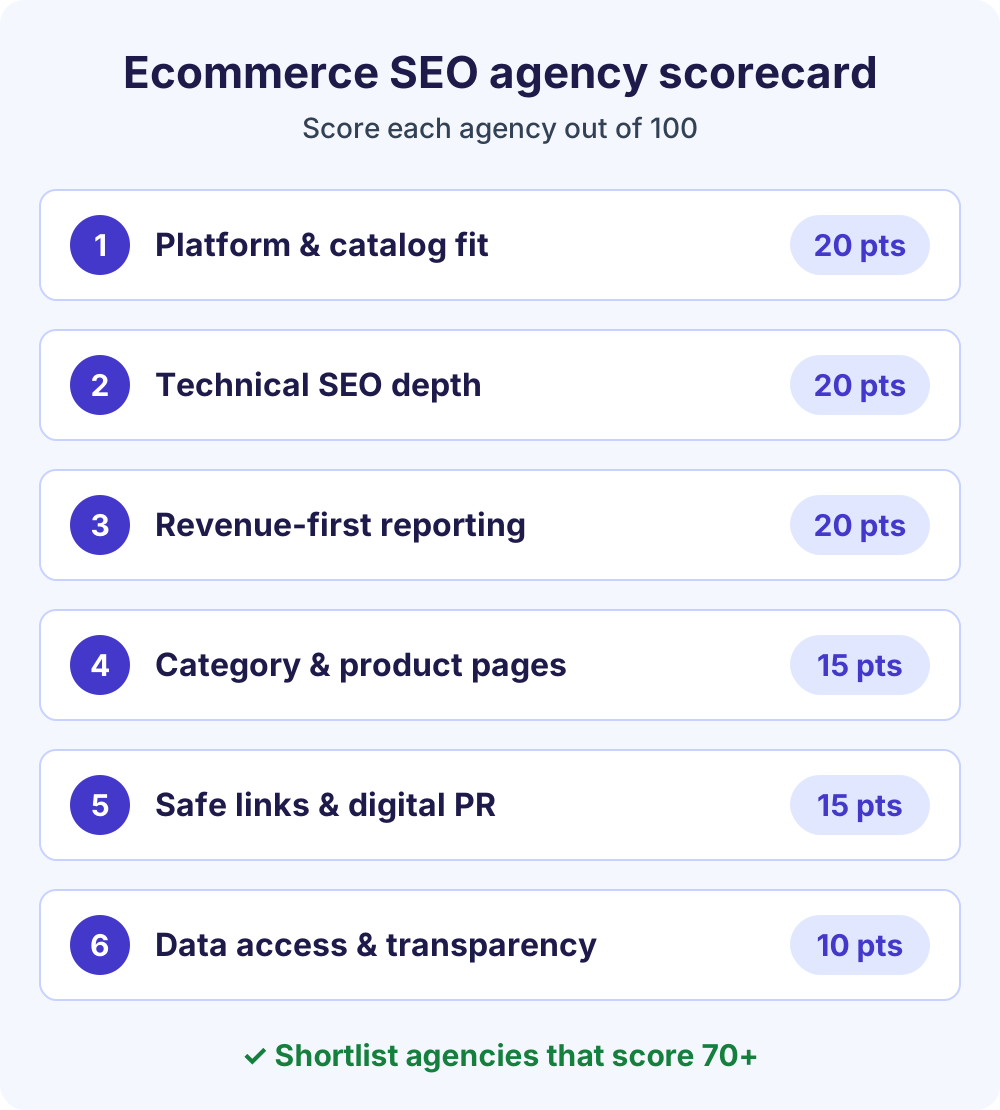
Platform and catalog fit come first because ecommerce SEO isn’t blog SEO. A store has thousands of product and category pages, seasonal stock and faceted navigation. A seven-figure Shopify Plus brand and a 40-SKU WooCommerce store need different playbooks, so the best ecommerce SEO company for you is the one whose past work matches your platform, catalog size and margins.

If an agency scores under about 70, or under half marks on any of the first three criteria, keep looking. Ask for the evidence behind each score: a sample audit, a sample monthly report and the strategist who will run your account.
Metrics that predict ecommerce SEO results
Traffic is the easiest metric to inflate and the least useful on its own, because it can rise on informational keywords that never convert while revenue stays flat. Before you sign, ask how the agency will report four numbers: organic revenue, organic conversion rate, revenue per category page, and indexed pages versus pages you want indexed.
Organic revenue tied to landing pages shows whether rankings are turning into sales. A capable partner reports revenue and assisted conversions from month one, not just rankings.

Case-study claims to treat with skepticism
“We grew organic traffic 400% in six months” rarely survives scrutiny. A store starting near zero can post a huge percentage gain from a handful of visitors, so growth without a revenue baseline means little.
Be cautious with undated rank-tracking screenshots, and ask for a 12-month view that spans at least one core update. Also ask what condition the site was in at the start: fixing a slow, broken site produces gains almost regardless of strategy, so the real skill shows after the easy wins.
10 questions to ask before you hire an ecommerce SEO company
Use these on every sales call to separate genuine ecommerce experience from generic SEO. Google’s guide on whether you need an SEO adds three more: ask for examples of past work, check business references, and ask what results to expect and in what timeframe.
- How do you handle crawling and canonicalization on faceted navigation and filtered URLs?
- What is your process for out-of-stock and discontinued product pages?
- Can you show organic revenue, not just traffic, from a comparable client?
- How does your strategy differ for a 200-SKU store versus a 20,000-SKU store?
- Which structured data do you implement for products, reviews and breadcrumbs?
- How do you prioritize category pages versus blog content?
- How did your clients’ sites perform through the last two core updates?
- How does scope change across a 12-month engagement?
- Who on your team actually works on the site, and what is their background?
- What will monthly reports show, and do they include revenue attribution?
Specific answers earn a second meeting. Vague or defensive ones usually mean the agency hasn’t managed a catalog at your scale.
How much do ecommerce SEO services cost?
Ecommerce SEO services are usually sold as a monthly retainer, a fixed-price project such as an audit or migration, or hourly consulting. The most cited benchmark is Ahrefs’ poll of 439 SEO service providers. It covers SEO in general, not ecommerce alone, so treat it as a floor for complex stores.
| Pricing model | How it works | Ahrefs survey data | What to check |
|---|---|---|---|
| Monthly retainer | Ongoing work for a monthly fee | Used by 78.2%; average $2,917/month ($3,209 for agencies); most common band $501–$1,000 | Scope should evolve over the year |
| Project | Fixed fee for an audit, migration or rebuild | Used by 48.9%; most common band $2,501–$5,000 | Clear deliverables and handover |
| Hourly | Billed by time, usually consulting | Used by 34.8%; average $111/hour; most common band $75–$100 | Fits teams with in-house developers |
| Performance-based | Fees tied to rankings, traffic or revenue | Not measured | Which keywords or events trigger payment |
Published ecommerce figures run higher. WebFX lists ecommerce SEO management from $2,900 a month, Inflow says effective SEO generally costs $3,000 to $5,000 a month, and Victorious recommends at least $6,000. Catalog size, platform complexity and competition drive the final quote.
Watch two things in any proposal. A retainer whose scope never changes over 12 months suggests the agency isn’t adapting as the site improves. And performance-based fees can push agencies toward easy vanity keywords instead of the commercial terms that pay the bills.

In-house vs freelancer vs ecommerce SEO agency
An ecommerce SEO agency isn’t the only route. The right choice depends on catalog size, how often the site changes, and whether you have developers who can ship fixes quickly.
| Factor | In-house SEO | Freelancer | Agency |
|---|---|---|---|
| Cost basis | Salary, benefits and tools | Average retainer $1,348.63/month (Ahrefs poll) | Average retainer $3,209/month (Ahrefs poll) |
| Skills | Deep store knowledge; one person’s skill set | One specialist, often strongest in one area | Technical, content, PR and analytics in one team |
| Speed to start | Slow: hiring and onboarding | Fast | Moderate: onboarding and audit first |
| Developer access | Direct | Usually through your team | Some have developers; confirm first |
| Best for | Large stores with constant change | Small stores, audits, second opinions | Growing stores that need several skills |
| Main risk | Single point of failure | Limited capacity and cover | Junior staff doing the work after a senior pitch |
Many stores combine routes: an in-house owner who sets priorities, plus an agency or freelancer for audits, migrations or digital PR. Whichever you choose, keep ownership of your Google Search Console, analytics and Merchant Center accounts.
Red flags that signal an ecommerce SEO company is overselling
Walk away from any agency that guarantees first-page or #1 rankings. Google’s hiring guidance says no one can guarantee a #1 ranking on Google, and warns against claims of a special relationship with Google or a “priority submit.”
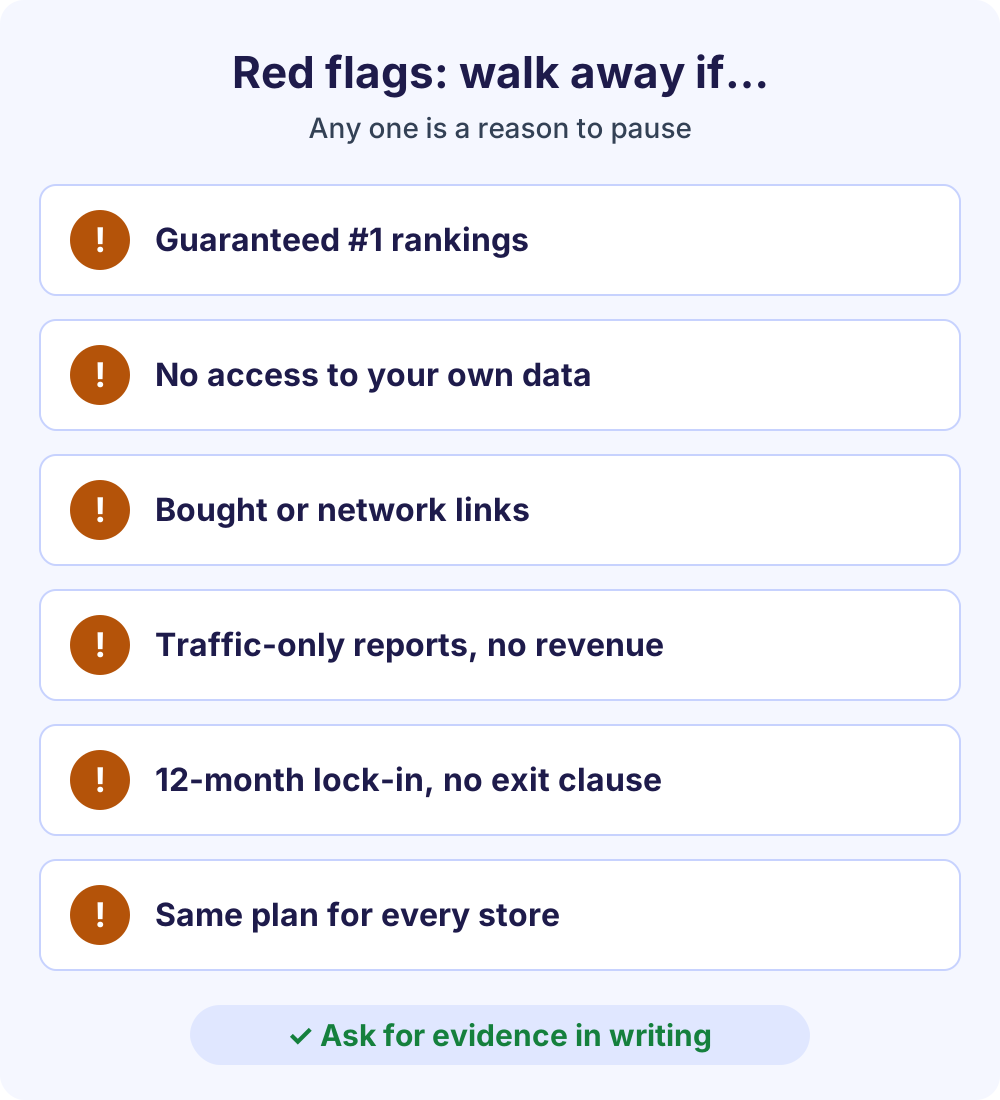
Other warning signs: a 12-month lock-in with no exit clause, vague link packages with no list of sites, reports with traffic but never revenue, and refusal to share your own Search Console and analytics data. For an initial audit, Google suggests granting read-only Search Console access rather than full rights.
What the first 90 days should look like
A well-run engagement starts with a technical audit and a prioritized fix list, not a content calendar. In month one, expect crawl, indexing and Core Web Vitals issues to be ranked by revenue impact, because a broken canonical on a top category page matters more than a typo on a quiet blog post.
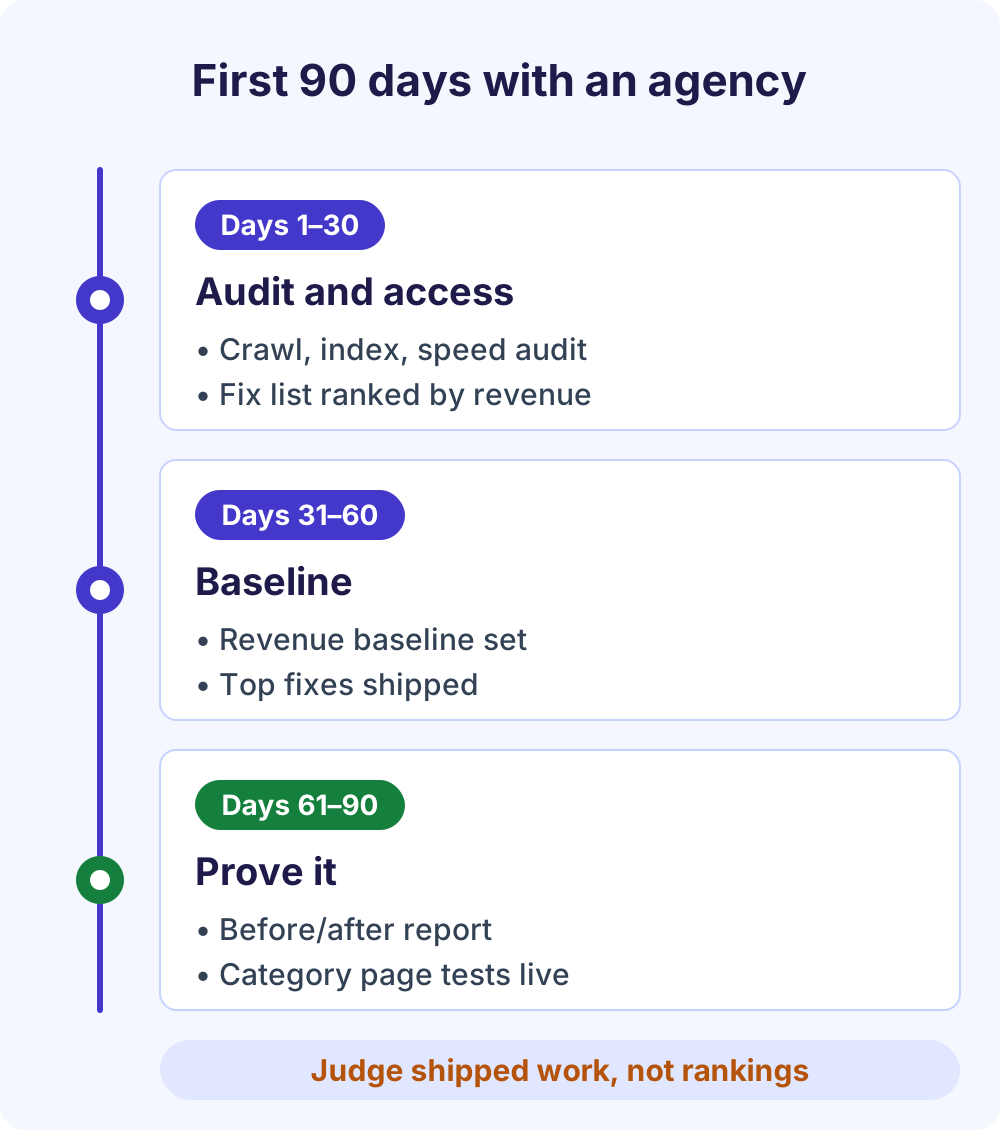
By day 60, you should have a baseline report locking in organic revenue, rankings and conversion rate. By day 90, a strong ecommerce SEO agency will have shipped at least one measurable technical fix and started testing category-page changes, with before-and-after data.
What results to expect, and when
Months one to three are mostly technical, and rankings often move little; judge this phase on whether fixes shipped. Months four to six are typically when category rewrites, internal linking and structured data start compounding, with impressions and click-through rate rising before revenue. By months seven to twelve, a capable ecommerce SEO company should tie revenue gains to specific pages and changes.
If you “tried SEO before and it didn’t work,” ask a new agency to diagnose what was actually done; often the category pages and technical foundation were never touched. And if you rely on paid ads, remember that paid traffic stops when the budget does, while organic rankings can keep earning.
Frequently Asked Questions
Who is the best ecommerce SEO agency?
There is no independent, audited ranking, and several “best of” lists are published by agencies that place themselves first. The best ecommerce SEO agency for you has proven work on your platform and catalog size, reports revenue rather than rankings alone, and explains how it earns links. Compare three or four on the same scorecard.
How much do ecommerce SEO services cost?
In Ahrefs’ poll of 439 SEO providers, the average monthly retainer was $2,917 and agencies averaged $3,209, though the most common band was $501 to $1,000. Published ecommerce figures run higher: WebFX starts at $2,900 a month and Victorious recommends at least $6,000. Catalog size, platform and competition drive the quote.
What is the difference between an ecommerce SEO agency, firm and consultant?
“Agency” and “firm” are used interchangeably for a company whose team covers technical SEO, content, links and reporting. A consultant is usually one senior specialist who audits, advises or trains your team rather than doing all the work. Consultants suit stores with in-house developers; agencies suit stores that need hands-on execution.
How long does ecommerce SEO take to show results?
Expect the first three months to focus on audits and technical fixes, with limited ranking movement. Category and internal-linking changes typically compound in months four to six, and page-level revenue gains should be visible within a year. Google doesn’t publish a timeline, so ask each agency what results it expects and by when.
Can an ecommerce SEO company guarantee first-page rankings?
No. Google states that no one can guarantee a #1 ranking, and it warns against SEOs who claim a special relationship with Google or priority submission. A credible ecommerce SEO company forecasts ranges from your own data, explains its assumptions and reports leading indicators such as impressions and click-through rate.
Should I hire an agency that specializes in my ecommerce platform?
Platform experience matters because Shopify, BigCommerce, Adobe Commerce and WooCommerce handle URLs, canonical tags, filters and apps differently. Ask for work on your platform at a similar catalog size. If you’re redesigning or replatforming, bring SEO in early; our Shopify development company checklist covers what to plan.
What should an ecommerce SEO agency report every month?
A useful report shows organic revenue and conversion rate by landing page, indexed versus wanted pages, Core Web Vitals, rankings for priority category terms, links earned and the work shipped that month. It should explain what changed and what comes next. If it shows only traffic and rankings, ask for revenue attribution.
Next steps
Pick three agencies from this shortlist or your own research, send each the same 10 questions, and score the answers on the scorecard. Before those calls, read what a real SEO audit should include so you can judge the audits you’re offered. If you’d like a quote from us too, see our SEO services.
Photo by Campaign Creators on Unsplash
Photo by path digital on Unsplash
Photo by Arum Visuals on Unsplash