
Hiring a shopify development company usually starts with a simple question: how much will this cost and how long will it take? The honest answer is “it depends,” but that is not useful when you are budgeting a launch. Soft Learn Hub has scoped enough Shopify builds to know the real cost bands, realistic timelines, and the exact checklist items that prevent a $6,000 quote from turning into a $15,000 invoice.
What a Shopify Development Company Actually Builds
A Shopify build covers more than picking a theme. It includes information architecture, custom sections, app integrations, checkout customization (on Shopify Plus), migration of existing product data, and performance tuning. Because each of these pieces touches the others, a good shopify development company scopes them together instead of quoting theme work alone.
Many merchants underestimate data migration. Moving thousands of products, variants, and historical orders from an old platform is often the single largest time sink in a rebuild, not the visual design.

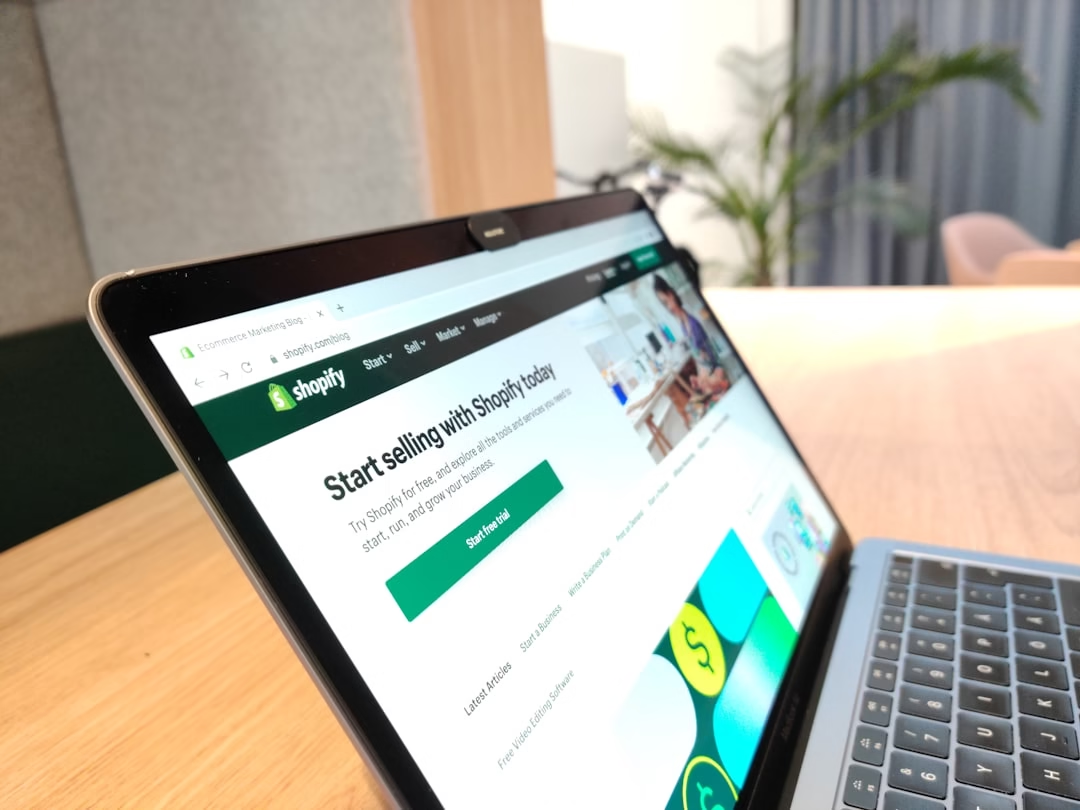
Photo by Arnold Francisca on Unsplash
Shopify Development Company Cost Bands in 2026
Simple stores built on a customized off-the-shelf theme typically run $3,000 to $8,000. Mid-size custom builds with bespoke sections and multiple app integrations land between $8,000 and $25,000. Enterprise Shopify Plus projects with custom checkout extensions, headless storefronts, or ERP integration commonly exceed $40,000.
These bands vary by agency location and seniority, but the pattern holds across the market: price scales with the number of systems the store has to talk to, not just the number of pages. A store with three integrations (email, reviews, inventory) will always cost more than a visually similar store with zero integrations.
How Long a Real Shopify Build Takes
A theme customization project usually takes three to six weeks. A fully custom build with multiple integrations takes eight to fourteen weeks. Enterprise Plus projects with custom checkout can run four to six months, especially when legacy data migration is involved.
Rushed timelines are a red flag. As a result, if a shopify development company promises a fully custom, integration-heavy store in two weeks, assume corners will be cut on testing, mobile QA, or migration accuracy. Testing across devices and browsers alone can take a week on a complex store.

The Scope Checklist That Prevents Change-Order Bills
Change orders are where Shopify budgets quietly double. Before signing a contract, confirm in writing: number of unique page templates, number of custom sections, exact list of third-party app integrations, who supplies product data and in what format, number of revision rounds included, and post-launch support hours.
Vague scope language such as “custom homepage design” invites disputes later, because “custom” can mean one hero banner or twelve bespoke modules. Insist on a wireframe or section-by-section outline attached to the contract, not just a word count.
Also clarify who owns the theme code after launch. Some agencies build on proprietary frameworks that lock you into their support plan; a reputable shopify development company builds on standard Shopify Liquid or Hydrogen so you can switch developers later without a rebuild.
Custom Theme vs Premium Theme: What to Recommend
Most stores under $2 million in annual revenue do not need a fully custom theme built from scratch. A premium theme, customized with bespoke sections, delivers 80% of the visual differentiation at a fraction of the cost and with far fewer bugs, because the underlying codebase has already been tested across thousands of stores.
Fully custom themes make sense once a brand has very specific interaction requirements, like a configurator or a non-standard checkout flow. A capable shopify development company will tell you honestly when a premium theme is the smarter choice, rather than upselling a custom build you do not need.
Apps, Integrations, and Hidden Costs
Every app added to a Shopify store carries an ongoing subscription cost and a small performance tax. Because page speed affects both conversion rate and search visibility, a good developer audits app bloat during the build rather than after launch. Ask your developer to list expected monthly app costs alongside the one-time build fee, so the true first-year budget is clear from day one.
For platform mechanics and app policies, Shopify’s own documentation is the most reliable source, and it is worth reviewing before your first scoping call so you can ask informed questions.
Once the store is live, technical SEO and organic visibility become the next priority; our guide to evaluating an ecommerce SEO company covers how to vet that follow-on work.
Vetting a Shopify Development Company Before You Sign
Ask to see a live store the agency built at least a year ago, not just a launch-day screenshot. A site that still loads fast and converts well after twelve months of real traffic tells you far more than a polished portfolio slide, because it proves the code was built to last rather than just to demo well.
Request a sample of their standard contract before the sales call ends. Look specifically for who owns the theme files, how many revision rounds are included, and what counts as a billable change order. A shopify development company that hesitates to share this paperwork early is usually hiding scope gaps they plan to bill for later.
Finally, ask how they handle a broken app integration discovered after launch. Because third-party apps update on their own schedule, integration bugs are inevitable over a year of operation. The answer should include a defined support-hour allowance, not a vague promise to “take care of it.”
What Ongoing Shopify Support Should Include
Launch day is not the finish line. Shopify itself pushes platform updates regularly, and themes, apps, and checkout extensions need periodic testing to make sure nothing quietly breaks. A fair support retainer covers monitoring for broken app integrations, seasonal theme adjustments for sales events, and a defined number of monthly support hours for small fixes.
Ask specifically what is billed separately versus what is included. Many agencies quote a low monthly retainer that excludes anything beyond “monitoring,” which means every real fix becomes a separate invoice. A transparent shopify development company will state a clear hourly rate for anything outside the retainer, so there are no surprise bills after a busy holiday season.
How Data Migration Complicates the Timeline
Merchants often assume migrating an existing store to Shopify is a simple export-and-import job, but real catalogs rarely cooperate. Custom fields, bundled products, subscription data, and years of customer order history frequently do not map cleanly to Shopify’s data structure, and someone has to manually reconcile the gaps.
A shopify development company that has handled migrations before will ask for a sample export of your current data before quoting a timeline, rather than estimating blind. If a proposal never asks to see your existing product data, assume the migration timeline in that quote is a guess rather than an informed estimate, and budget extra time accordingly.
Key Takeaways
A trustworthy shopify development company will give you a scope document, not just a price. Confirm templates, integrations, and code ownership before signing, and treat any two-week promise for a complex build with healthy suspicion. Soft Learn Hub built this checklist from real project scopes so merchants can budget accurately and avoid change-order surprises. Bring it to your first scoping call, and use it to compare quotes side by side rather than judging any single agency in isolation.