
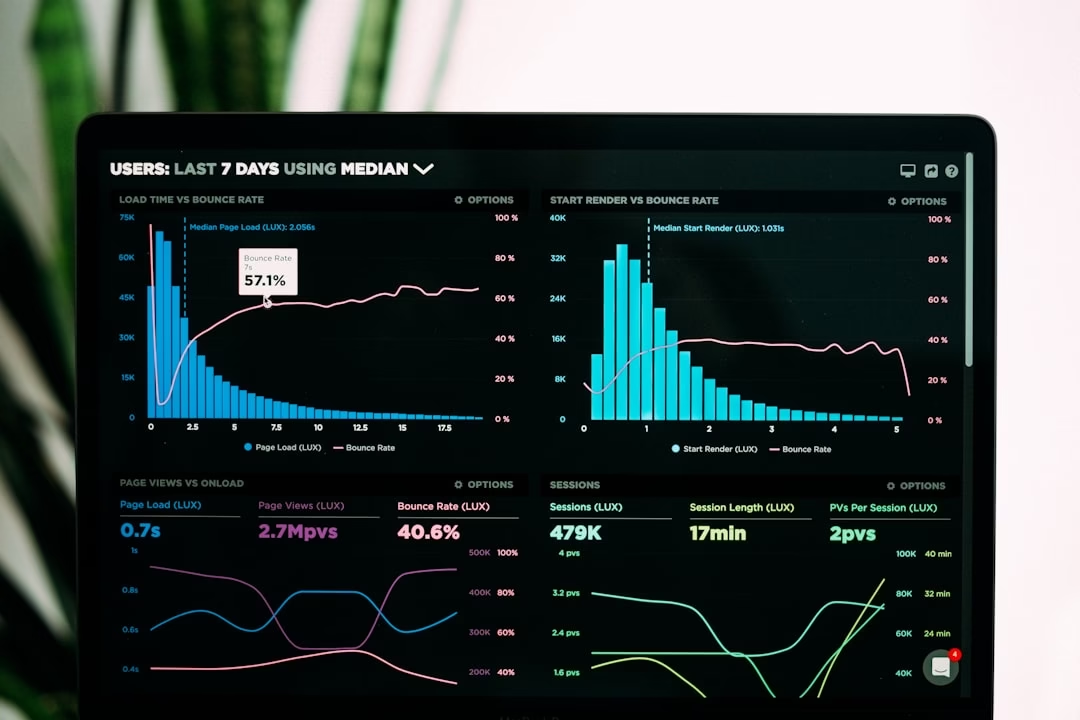
Most PPC reporting defaults to cost-per-click as the headline metric, because it’s the easiest number to report and the one every platform surfaces prominently. For a B2B business, this is close to meaningless. A B2B PPC agency worth working with reports on cost-per-qualified-lead — and ideally cost-per-opportunity or cost-per-closed-deal — because a cheap click that never becomes a real business conversation is worthless, no matter how favorable the cost-per-click number looks in a monthly report.
Why Cost-Per-Click Misleads in B2B
A B2B campaign can post an impressively low cost-per-click while generating almost no genuine sales pipeline, if the traffic it attracts doesn’t match the actual buyer profile — students, researchers, or job seekers clicking a B2B software ad out of curiosity rather than purchase intent, for instance. Conversely, a campaign with a higher cost-per-click but tightly targeted at genuine decision-makers in the right company size and industry can produce dramatically better pipeline results despite looking worse on the simplest surface-level metric.
Setting Up Proper Cost-Per-Lead Tracking
Getting to cost-per-qualified-lead reporting requires connecting ad platform data to actual CRM outcomes — which leads from which campaigns became sales-qualified, and ideally, which became closed revenue. This is more setup work than the default conversion tracking most agencies configure out of the box, requiring integration between the ad platforms and the client’s CRM system, and a shared definition with the sales team of what actually counts as a qualified lead in the first place.
Platform Selection for B2B Paid Campaigns
LinkedIn Ads offers the most precise B2B targeting available — company size, industry, job title, seniority — but at a meaningfully higher cost-per-click than most alternatives, reflecting that precision. Google Ads captures high-intent search traffic from buyers actively researching a solution, often at a lower cost-per-click but with less inherent targeting precision than LinkedIn’s firmographic data provides. Many effective B2B PPC strategies run both in tandem: Google Ads capturing active search intent, LinkedIn building awareness and capturing attention from the right audience even before they’ve started actively searching.
Account-Based Marketing and Paid Media
For companies running account-based marketing (ABM) targeting specific named accounts, paid media can be configured to specifically target those accounts — LinkedIn’s company targeting and various programmatic ABM platforms allow this kind of precision. A B2B PPC agency familiar with ABM can integrate paid campaigns into a broader account-based strategy rather than running paid media as an entirely separate, disconnected channel from the account-based approach the rest of the marketing team is executing.
Fee Structures Common in B2B PPC Management
Percentage-of-ad-spend (typically 10-20%) remains common, though it can create a subtle misalignment where the agency benefits from higher spend regardless of efficiency. Flat monthly management fees avoid this specific conflict, and some agencies now offer performance-based components tied to cost-per-qualified-lead targets, more directly aligning agency incentive with actual client outcomes. Within a broader B2B marketing strategy, paid media typically works best as one coordinated channel among several, not an isolated tactic evaluated purely on its own standalone metrics.
The underlying shift required is philosophical as much as tactical — evaluating a B2B PPC agency, and holding them accountable, against pipeline and revenue outcomes rather than the surface-level metrics that are easiest to report but least connected to whether the campaigns are actually growing the business.
Landing Page Quality Determines Whether Good Traffic Converts
Even perfectly targeted B2B paid traffic underperforms if it lands on a weak page — generic messaging, no clear next step, a lengthy form asking for too much information before the visitor has any reason to trust the company enough to provide it. A competent B2B PPC agency should either build or closely collaborate on landing page strategy specifically for paid traffic, rather than simply directing all paid clicks to the same general website pages built primarily for organic visitors with different context and intent entering the site.
Testing landing page variations — different headlines, form length, social proof placement — against the same paid traffic source is one of the highest-leverage optimizations available, often improving conversion rate more than incremental bid or targeting adjustments within the ad platforms themselves.
Negative Keywords and Audience Exclusions Matter More in B2B
Given B2B’s typically smaller, more specific target audience compared to consumer campaigns, negative keywords (terms explicitly excluded from triggering an ad) and audience exclusions carry disproportionate weight in campaign efficiency. Excluding job seekers, students, and researchers from search campaigns, and excluding company sizes or industries that don’t match the actual target customer profile from LinkedIn campaigns, prevents budget waste on traffic that will never convert regardless of how well the ad itself is written or how appealing the landing page is.
B2B PPC Agency: Frequently Asked Questions
What’s a reasonable cost-per-qualified-lead benchmark?
This varies enormously by industry and deal size — a B2B software company selling a $50/month product has very different economics than an enterprise software company closing $100,000+ annual contracts. The right benchmark comes from working backward from acceptable customer acquisition cost relative to typical deal value, not a generic industry average.
Should a B2B company run LinkedIn Ads, Google Ads, or both?
Most established B2B companies benefit from running both, since they capture different points in the buyer journey — LinkedIn for awareness and firmographic-precise targeting, Google Ads for capturing active, high-intent search demand. Earlier-stage or budget-constrained companies sometimes need to prioritize one initially based on which better matches their specific sales motion.
How long before B2B PPC campaigns are optimized and performing well?
Initial campaigns typically need 4 to 8 weeks of data before meaningful optimization decisions can be made confidently, given B2B’s naturally lower click and conversion volume compared to consumer campaigns, which take longer to accumulate statistically reliable performance data.
Is it worth running PPC alongside organic SEO, or should budget go to just one?
Most mature B2B marketing programs run both, using PPC to fill pipeline gaps while SEO’s slower, compounding organic growth matures. Very early-stage companies with limited budget sometimes need to prioritize one initially, typically PPC for faster feedback on messaging and audience before investing heavily in longer-term SEO content.